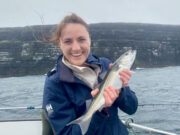
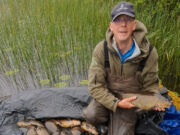
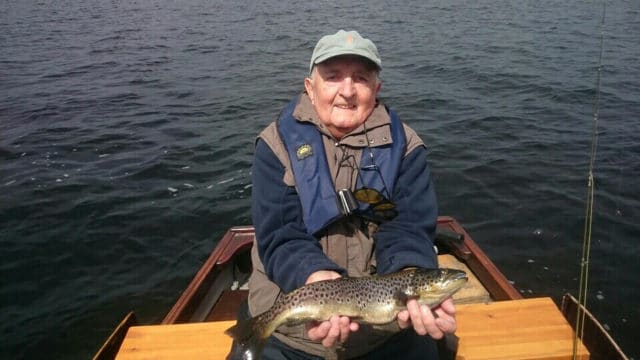
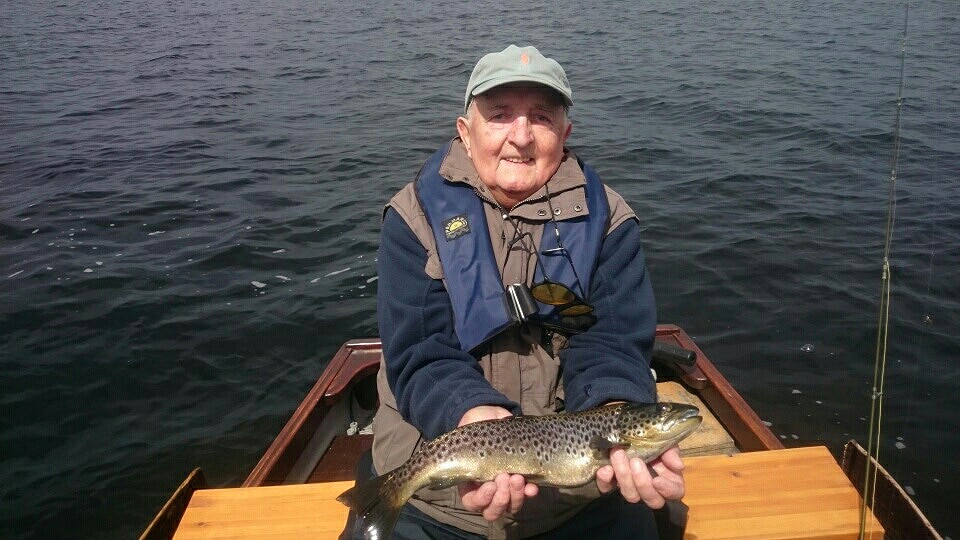
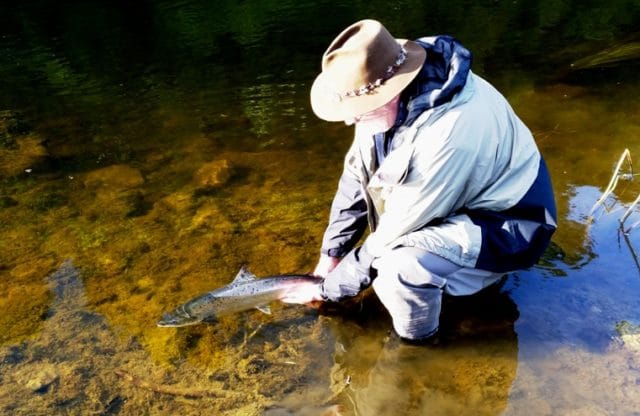
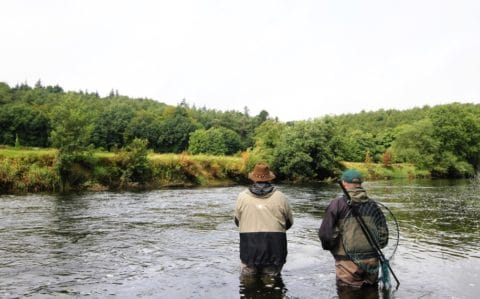
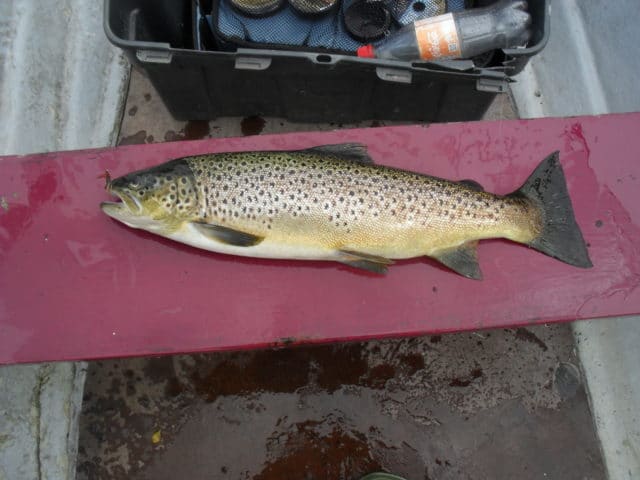
Brendan Burke from Dublin, still tempting wily Corrib trout in his 86th year, with a nice trout caught recently with Larry McCarthy.
Declan Gibbons reports the last week saw good fishing for anglers to mayfly and sedge patterns, with less rod pressure on Lough Corrib due to anglers practicing and participating in the World Cup final on Lough Mask. Basil Shields of Ardnasillagh Lodge, Oughterard (091-552550) reports John Maher landed 3 trout on dry sedges on Sunday, with the best fish being 2lbs, and on Wednesday Myles McHugh caught 2 trout on dry mayflies – best fish 2.75lbs. Staying in the Oughterard area Kevin Molloy of Baurisheen Bay Boat Hire (087-9604170) says visiting French anglers Mr Pierre Delbar and son had 3 trout trolling on Monday last – best fish 2.75lbs – and on Tuesday Mr Sebastian Michelle, another visiting French angler, had 2 trout trolling for a half a day’s fishing.
In the Cong area Frank Costello of Ashford Bay Boat Hire (087-2524253, www.ashfordoldschoolhouse.ie) reports there is good fishing still to be had in the area, with Jim Connell of Ballaghadereen and Manchester catching 4 trout up to 1/75lbs, 3 of which were sportingly released. Jim caught the trout on wet fly and also had numerous smaller fish on his trip to Lough Corrib.
In the Greenfields area angler Andrew Boyd and visiting English angler Ben Watson enjoyed a good day’s sport on dry may fly and sedge patterns, boating 5 trout between 1.5lbs and 2.5lbs.
Larry McCarthy from Corrib View Lodge (087-9135222, www.corribangling.com) was also in touch to report good fishing for clients. Larry says it was another good week on Corrib with trout on sedge and mayfly patterns; some notable returns were Brendan Burke and Pat Orange from Dublin catching 4 trout on Monday and Tuesday between 2.5lbs and 3lbs – well done Brendan in his 86th year still pulling them out. Paddy Kinneavy fished with Larry on one day and boated 8 fish between 1.5lbs and 3lbs, all on mayfly patterns. Saturday produced 6 trout to dry sedge patterns in the Greenfields area, all sportingly returned.
Brendan Burke from Dublin, still tempting wily Corrib trout in his 86th year, with a nice trout caught recently with Larry McCarthy.
Upcoming Competitions
The Corrib Federation Cup (Catch & Release) is being held on the 23rd of August out of Birchall. Fishing is from 11am to 6pm on a catch, measure and release basis. Entry is €25, with all proceeds going to the federation’s fundraising for habitat improvement works on the rivers around Corrib. Entries must be in to Philip Comber at 086 2786301 by Thursday evening when the draw takes place.
Frank Butler was in touch to say that Collinamuck and District Angling Club are hosting the Galway Wind Park Cup on Sunday August 30th, with fishing from 11am-6pm and an impressive €500 in prizes. This is a dapping/casting competition and all are welcome. Enquiries to Frank on 087 329077 or Dave on 087 8507561
Brian Joyce from Derrypark Lodge with a magnificent 15.5lbs ferox trout caught on Lough Mask
Last Saturday finally saw an end to the 2015 World Cup on Lough Mask, after being postponed for almost 2 weeks due to adverse weather conditions on the original date. As always the competition was well supported, with just over 500 anglers participating in this year’s event. The final day began with light winds, which for many dry fly anglers was a dream come true, but as the day progressed, the breeze strengthened and the playing field levelled.
This year’s winner was a very popular David Corcoran from Tuam, Co Galway. David weighed in 4 trout, but also had an additional trout on his ticket which was added to his overall weight using a length/weight conversion chart. The winning catch was 5 trout weighing 5.708lbs. In second position was Darren McGuire from Garrison Co Fermanagh, with 5 trout weighing 4.9010lbs. Third place went to 2013 winner Eugene McCarty from Galway, with 3 trout for 4.4760lbs. Heaviest fish winner was Dominic Kerrigan also from Garrison Co Fermanagh, with a trout of 4.1101lbs.
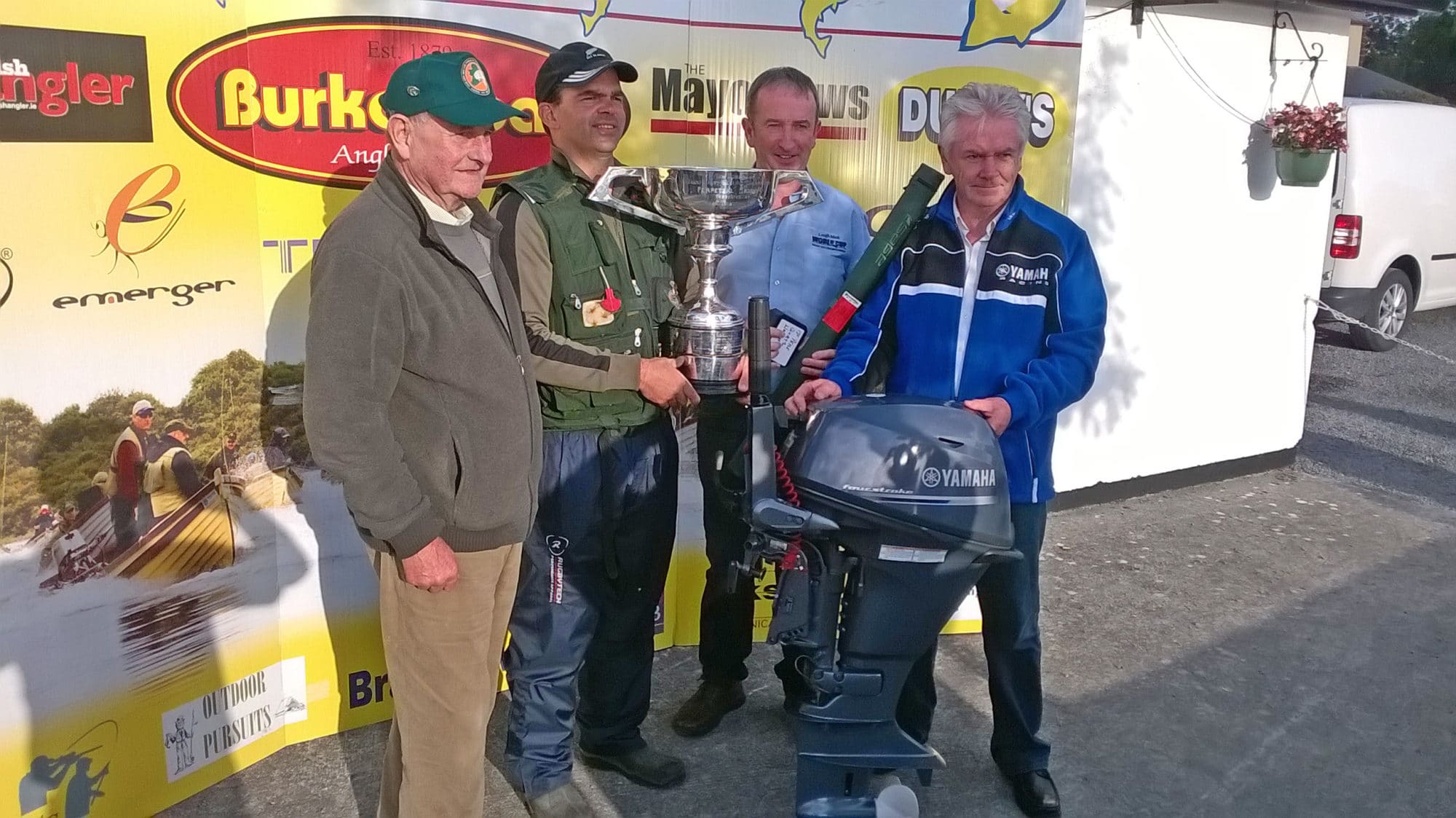
David Corcoran, winner of the World Cup Flyfishing Championships 2015, with main sponsor John Paddy Burke (Burke Boats), Kevin Egan (Chairman, World Cup organising committee) and sponsor Tom Staunton (RS Marine).
The best under 21 was Gerard McLoughlin from Kells, Co. Meath with an impressive catch of 5 trout weighing 5.494lbs on his heat day. Gerard is a son of the late well-known river and lake angler Pat McLoughlin. Gerard was unable to compete in the final, due to the fact he was representing Ireland in the World River Championships in Colorado, USA on the same weekend. The World Cup committee offered him huge congratulations on his achievement and presented Gerard with a free entry to the 2016 competition. Well known international angler Dorrie Gibbons from Cong took the best lady angler prize with 4 trout weighing 5.826lbs.
Partry Angling Club held their annual development fund raising pairs competition over the weekend, which was supported by 157 anglers from all across the country. Competitors had the option of fishing either Carra or Mask on the day. Conditions were difficult, with light winds and bright sunshine which made for tough going. This year’s winning pair was Shay Cash and David Bohana, both from Dublin with 4 fish weighing 7.74lbs. In second place were brother and sister team, Martin and Kathleen Feerick from Partry, with 3 fish for 5.245lbs. Third place went to loyal Lough Carra anglers Emmet Stagg and Joe Conroy, with 3 trout for 4.56lbs. Hugh Marshall and Raymond Massey weighed in the heaviest fish which was 2.385lbs.
Brian Joyce from Derrypark Lodge with a magnificent 15.5lbs ferox trout caught on Lough Mask
The first cast of the day resulted in a 10lb 7oz bass
John Quinlan from Thatch Cottage Ireland reports that the bass are hitting surface lures at the moment. john tells u that this has to be the best way to catch bass.
Getting bass off the surface is exciting stuff.
There is no denying that catching bass off the top is very exciting. Between the chases, follows, tail slaps, hits and misses its hard to become a ball of nerves. But the traditional methods are still worth trying…
Stephen Brennan of IrishSportFishing.com was also fishing the Waterville area. Fishing with Dave Roe he reports that nothing was obviously different about this day in the Waterville area than any other day…
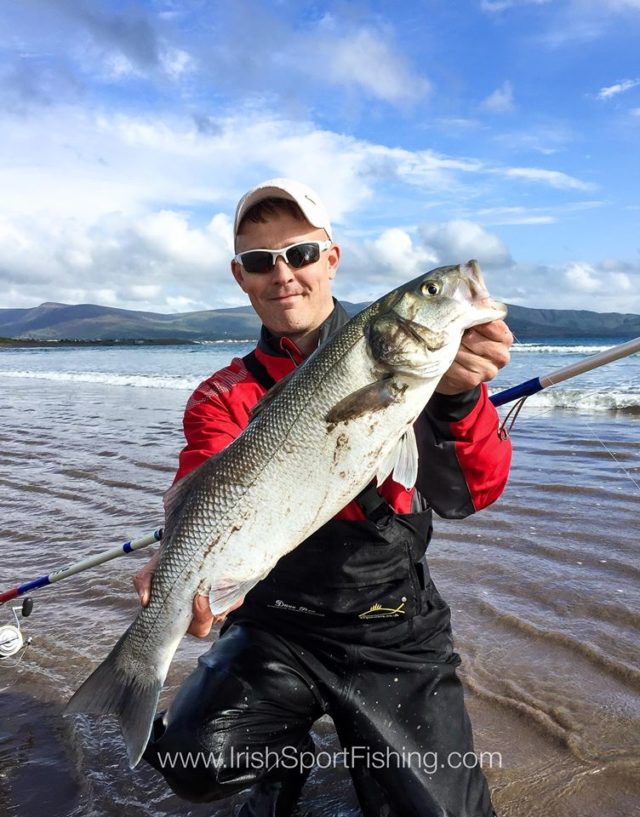
The conditions were OK, the surf was OK, the tides weren’t bad, etc. Dave had his first cast and within 5 minutes had a slack line bite resulting in a 10b 7oz bar of silver.
The first cast of the day resulted in a 10lb 7oz bass
After a few quick photos and measurements we sent her on her way. And that was it for the day – not another bite! We could fish this spot for another ten days and not see another fish like this. Fishing is great, isn’t it?
Go fishing…
John Quinlan, Thatch Cottage
Lure and fly fishing for bass normally begins mid to late March with April and May often giving superb sport. Please get in touch to check for best times and availability. If you fancy a bass fishing break just give John a call on (066) 947 4721 (or +353 66 947 4721 from abroad).
Liam and Sheila from Ballybay Angling Association have posted a lovely video done by Go & Catch Feeder Fishing Team, on the open match which was held on Lough Egish on 16th August 2015. The video shows the venue, the fishing, some tactics used, photos, faces and the presentation. Enjoy!
Additional Information Can be Found at the Links Below
Another Stunning Sunset On Lough Ramor in Co. Cavan
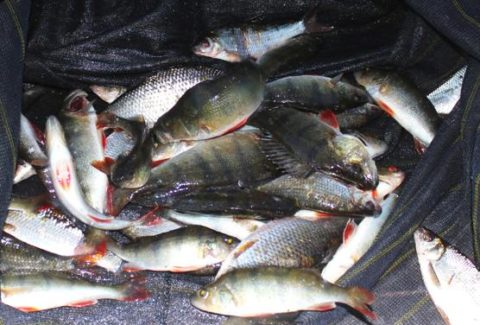
A blistering hot day on Tuesday 18th August did not thankfully deter all species of fish from feeding on Lough Ramor in Co Cavan but only the tough guys were out in the midday sun. Water was very clear and temperatures hit the low 20’s. Despite efforts to attract hybrids and roach it was mainly perch that made up the catch at the Coronagh wood stretch. When landing one of the larger fish I was surprised to see a cloud of dozens of white maggots appear from his mouth as he neared the net. This was because I had not fed white maggot and obviously this fish had been availing of some other anglers hospitality. As the light faded it was expected that the more shy fish would appear but unfortunately, not on this occasion. That being said the perch provided an interesting session on this great water. Feeder tactics with light feeding and red and white maggot worked well.
Perch Made Up the Bulk of the Catch on Ramor on TuesdayAnother Stunning Sunset On Lough Ramor in Co. Cavan
Water conditions are very low and clear in the River Boyne at the moment and a drop of rain and rise in water levels would not do any harm at all. There are a few fresh fish about and this always increases chances of hooking up. Today Wednesday 19th August saw Patrick Coleman from the UK fishing the lower Boyne at Oldbridge with local angling guide Peter Cunningham. Patrick was armed with his new double handed salmon rod and fished all of the best holding areas with Peter throughout the course of the day. At the lunch break no fish had been registered save a small trout or two.
On arriving back for the evening session one or two fresh fish had shown along the stretch and at about 7pm Patrick was into his first fish a beautiful fresh run salmon estimated to be around 8lbs. The fish battled hard but was brought the net as quickly as possible to avoid overtiring the fish. After unhooking and a quick photo the fish was returned immediately to water where it was given plenty of time to recover prior to its release.
Peter Cunningham is one of the North East’s top angling guides. If you fancy a days guided fishing for salmon, sea trout, wild brown trout, pike or bass, then why not give him a call or drop into him for a chat in the Drogheda Angling Centre, Boyne Shopping Centre, Drogheda.
Peter can be contacted by Tel: 086 4682516 or byemail: [email protected]
Patrick Coleman With Angling Guide Peter Cunningham on the Boyne at Oldbridge This MorningWaiting For That “Pull” as The Fly Travels Across the RiverPatrick Throws a Line at the Curly Hole on the Oldbridge FisheryPatrick With His First Boyne SalmonPatrick Assists the Salmon to Recover Prior to ReleaseA Beautiful Boyne Salmon Is Successfully Released Back to the River
Sean Carty of Carty’s Land and Sea Sports in Bundoran reports:
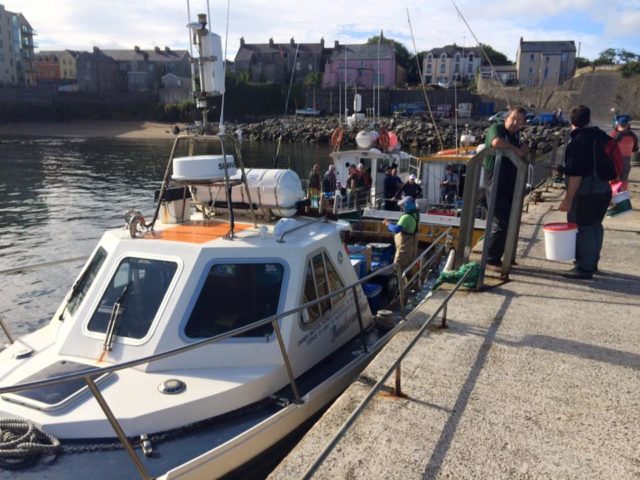
Sunday 16th August saw the annual Bundoran SAC open boat competition . This years event under the watchful eye of club chairman Tom Martyn and local competition organiser Boris Seigel was one of the most successful club competitions held in recent years . Anglers travelled from England , Wales and every corner of Ireland to take part in this years event . There was a great atmosphere in the air as the boats left the boat quay in Bundoran which had been decorated by the clubs members with buntings . As always in Donegal bay fishing was fantastic with many different species caught . Lines up was at 4.30 pm and on return to the pier all involved went the 100 metres to the Marine bar in the West end for the prize giving . There was an exceptional spread of food put on for the anglers at no cost by the Marine bar which everyone enjoyed while the scores were being counted . After the food the results were read out and the prizes were handed out . In 1st place the winner of this years Bundoran open was Liam O Connor who was followed closely by his brother Mark O Connor in 2nd place , 3rd place went to local club angler Michael Patton and in 4th place was Martin Kennedy of shamrock tackle fame . The 5th and final prize position went to Corney Devlin .The prize for the longest fish went to Liam O Connor . The prize for most species was won also by Liam O Connor with 13 species and the best Lady angler on the day was Yvonne Carrey .
Bundoran Open
Bundoran Sea angling club would like to take this opportunity to thank all of our sponsors . Without there help there wouldn’t be a club . This year the club has worked extra hard on a number of levels to promote sea angling in the area and after much planning and preparing submissions by the club officer board ( Tom Martyn , Sean Carty ( Cartys Land and Sea Sports ) , Boris Siegel , Patrick O Doherty ( Bundoran Star ) and Declan Kilgannon ( Kiwi Girl ) we have secured one of the biggest sea angling events on the planet for Bundoran and Donegal Bay . Next month the World boat sea angling competition will be held in Donegal bay seeing team from all over the globe arriving into Bundoran to compete . The event will be a welcome boost to our local economy and will be a unique opportunity for us to showcase the world class sea angling product that we are so lucky to have on our doorstep . Finally as always the club is always open for new members and sponsors and contact can be made through any of the committee , Tom Martyn , Sean Carty ( Land and Sea Sports ) , Boris Siegel or Patrick O Doherty ( Bundoran Star)
Following a mention of his writings on dapping in last week’s Sheelin report, Ronnie Chism was in touch to offer the full article on dapping for you reading pleasure…
MY WAY OF DAPPING WITH NATURALS AND ARTIFICIALS
Dapping to most anglers is just practiced at mayfly time or in August when the daddy long legs and the grasshoppers hatch but there is a lot more to dapping than meets the eye.
Let’s start with the set up we need to have a comfortable days dapping; if the rod isn’t right your beat before you start. The rod has to be light, easy to handle and around 14 ft. long with a standard trout fly reel. Your wrist and arm you will soon let you know if you have the wrong rod. Dapping Naturals is as old as time so there is no real secret to it but there are a few small points that will help anyone to improve. To collect the flies you will need a minnow net to lift them of the surface or go to the shore to where the fly is being blown onto. If it’s a wet day the fly will be sitting on the stones or the tree stumps close to the water’s edge. On the other hand if it’s a warm breezy day the fly will collect high on the trees at the back of the leaves and the tree trunks, so try to pick the big fresh ones not the dark black ones and then put them into your dapping box as shown in the photo.
Dapping box
Firstly, you don’t need floss because in a squally wind the fly will blow all over the place and it is harder to control. You are better to just use 5/6 lb nylon attached to 20 or 30lb braid as this is finer and lighter when compared to nylon but if you have to use floss, a meter is plenty. Furthermore the best wind for dapping is a steady breeze as it allows for greater control of the fly. You can also vibrate the top of the rod gently by moving the rod hand to mimic a struggling fly.
Next thing we need to look at is hooks. Now the best hook I found over the years is Kamasan B983 size 10 and you should tie the hook upside down onto the nylon so to make the two mayflies sit on the shank and not slide down on to the bend of the hook into a lump. The best place to put the hook is at the brown spot at the thorax of the fly, by holding the fly’s wings between your finger and thumb and pushing the hook through the brown part then gently push the fly up the shank. Repeat the process with the other fly make sure the two flies are facing the same way and sitting upright and across the shank with their feet sitting on the water, not lying to the side or flat. If you use too big of a hook it takes a lot more work to keep the flies on the surface not in it, a heavy hook will drown the flies a lot quicker and the fish feels the larger hook and will consequently spit the flies out. If you are new to dapping putting the flies on can be tricky at the start but with a bit of practice you will soon get used to it. Also if it’s a wet day keep an old towel in your box so as to dry your hands before putting the flies on as sometimes the wings of the flies will stick to your fingers and pull off.
Dapping with the Daddy Long Legs is much the same as the mayfly but you have to handle the daddies a lot more gently because you can pull the wings and legs off very easily. The best time to collect the daddies is first thing in the morning especially if there is heavy dew as you can find them down in the clumps of rushes and long grass where they won’t move very much until the sun warms them up and then you will need a small children’s beach net to catch them.
In addition you will need some thing to keep the daddies in and the best thing I’ve found is a plastic sweet jar with the top wide enough so you can put your hand in. Take the lid off and get an old piece of rubber wide enough to cover the top, an old car tube is perfect cut the tube open and place the lid onto the rubber and mark roughly about two inches wider than the top. Fix it over the opening of the jar with a cable tie or tape then take a sharp knife and cut a cross shape in the rubber that covers the top opening. The rubber will fold around your wrist and stay in shape when you reach in to take a fly out so you don’t have any lid to open and the flies won’t escape. Finally put a couple of air holes in the jar and bobs your uncle. See photo of the jar.
Put the daddies on the hook the same as the mayfly; at the thick part where the legs join the body. Two flies is plenty but you can put on more if you wish though a lot of fish will slap at them and try to drown them. And a lot of fish will be missed. Keep a good eye on the flies when this happens for a lot of the time after the rise the flies will still be there don’t move them for some times the fish will come back and take them with more confidence. It takes the trout a while to come onto the daddies. When they first appear you need a good wind blowing sufficient numbers of the land from the same quarter for several days before the trout get accustomed to them and they will then take them freely.
Dapping the cricket and the locust is much the same and they are handier got than grasshoppers in some parts of the country and work equally as well. They are very good even when the mayfly is out and better still when sedges are about. If the breeze is not too strong and you have the right dapping rod you can work the cricket with a little movement from the rod top and with a bit of help from the breeze you can make the cricket skitter across the water like sedge, the trout make no mistake when they come for it.
In 2009 I was fishing on the lake for a few days where I had a couple of trout hard fished for from an east wind with a harsh light on the dap. On the last day the fly was hatching and blowing down from bog bay and I could see the trout taking the fly down wind in front of me but in a splashy type of rise way out over the deeps. I drifted up and down through these trout with the dap for two hours and could not move a trout. As the rise form was not the rise of fish confidently taking mayfly I put on the dries and thought it would be better to target single fish. Several trout showed up in front of the boat and I had no problem seeing what direction they were going. I covered them well in front and tried to put it on their noses but it was a waste of time. I could not get an offer so I pulled the boat onto the shore to try to figure out what was going on.
The flies were sitting thick on the water and the more I watched I noticed that they weren’t that interested in the fly on the top as not even one mayfly was touched. After watching till I was fed up I saw a sedge scurry across the surface, he didn’t get ten yards until the water opened and the sedge was gone so onto my rod went the cricket. I started the drift again and I hadn’t gone very far with the cricket tracking the water just like the sedge, when a big head and shoulders appeared and down went the rod to the top of the water. I waited a few seconds, lifted the rod then everything went solid and after a good fight I netted the 3/5lb trout with a hook in roof of the mouth. I thought I had cracked it! I spooned him right away expecting him to be full of sedges but instead he was full of mayfly nymphs, most of them with the wings just opened. The fish on that particular day wanted the fly half in half out of the surface because of the splashy rise form. Before the rise finished I had four trout on the cricket for almost 12lbs. All fish returned bar one to fight another day, if I hadn’t had the crickets I don’t think I would have got a fish. Who knows?
A big klinkhammer might have worked but that’s for another day so don’t always think that when you see a rise they are taking files of the top. Timing the strike when dapping is the fun part, the most importing thing about timing the strike is do not take your eyes of the fly. The takes come in a leisurely fashion if the fly is presented correctly and nine times out of ten a fish that comes with a splashy rise will be small trout. The one that comes even in a big wave with a sip like a trout taking a spent in a flat calm is the boy you want, though if your not watching the dap this take can go unnoticed and next thing you know the best fish of the day has come and gone. These big fish don’t make too many mistakes but with the dap they do.
Apart from spent gnat fishing there is nothing more satisfying than at mayfly time when drifting down a shore dapping you see a fish tacking a fly of the top, a pull on the oar brings you in line with him and the dap is sitting perfect the heart picks up a beat in anticipation. It seems like a long time but it is merely seconds. For that moment in time the world stops until you raise the rod. If you have done everything right then all you need to do is drop the rod as soon as you see the rise to the top of the water, let it sit a second or two then lift the rod back up. If at the initial take the fish feels any resistance he will spit the fly out. If the wind moves the fly as it sometimes does, just as a fish is about to take get the flies down onto the water as quick as you can even if it means letting the line fall onto the water. Almost all of the times he will come up and take the dap if you can get it back onto the water quickly and if the hook is tied as above then the trout will be hooked in the top of the mouth.
The result of good dapping…
Dapping with the artificial is a different ball game. You can dap any kind of fly you like provided there is enough hackles on it to keep it afloat as it skips over the waves. If you take wet fly fishing for example mostly the best fly on the cast is your top dropper for attracting fish so you try to keep it bobbing on the water at the end the cast for as long as you can. With my light dapping rod you can work your dapping fly should it be a size 12 bumble or a large sedge hog all day long as you are not restricted by different types of flies. When fishing wet flies from a boat drifting down a shore you are casting your flies down in front of you and retrieving them back more or less in a straight line but with the dap you can sweep the fly from side to side covering half the length of the boat and you are showing the fly over a far wider area and covering far more water with less effort.
Now comes the hard part, the takes come in a couple of different ways and as I said before do not take your eyes of the fly. Sometimes when the fly is tracking across the waves the fish will follow the fly until it reaches the end of its journey. When the fly stops momentarily and just before it starts to sweep back this is where the trout will take it. You would nearly think that the trout knew the fly was going to stop and you have to treat this take as you would a dry fly take and let the fish turn down. The other scenario is when you’re skirting the fly over the waves and the trout head/tails on your fly you have to give him time to turn down, just drop the rod to the water and lift it straight up again. If on the other hand the fish makes a splashy rise strike as you would when fishing wet fly.
The great thing about the dapping technique is if you want to fish the dry fly on a day with a nice breeze should it be a wolf at mayfly time or a small sedge just let the wind take fly out in front of the boat then you can lift it and set it at three different angles in front of you as you would with dry fly. You don’t need to let the fly too far out in front of the boat, just over a rods length is plenty. I’ve often caught trout beside the boat in a light breeze, and you should just lift into the fish the same way as you do for the dry fly. Sometimes when dapping at mayfly time the trout might be slow at coming to the dap, a trick I do sometimes is to put a wolf or large sedge hog on and skate it across the water and this will bring the them up. You seem to catch a better class of fish at this method and I think it has something to do with no fly line or cast lying on the water so there’s nothing to spook the fish, well it works for me.
This is how I go about my dapping and I find it good fun and a change for the better as there is so much more you can do and experiment with. It took me a long time to get the right dapping rod and I ended up cutting rods to get the right action and weight and now I have it. The rod I use is a 14ft four piece and weighs 6 oz. It’s like a wand in your hand whereby you can feel a fish of a pound on it to being able to handle a 5 or 6lb plus. So there you have it, give it a go and you will not be disappointed! It will open up a whole new avenue in fishing for anyone who wants to experiment with different ways to present flies, be them natural or other wise. When fishing in rivers or lakes dapping is the only way to do it.
P.S If anybody uses a spinning reel on a dapping rod, well I wouldn’t trust them with my granny.
If you would like further information on the technique or the equipment I use then do not hesitate to contact me via email: [email protected]
All Rights Reserved
No part of this can be copied or altered by order of R Chism
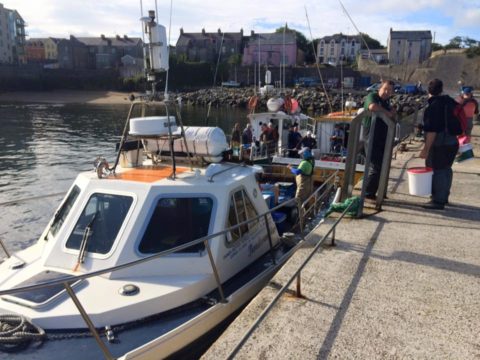
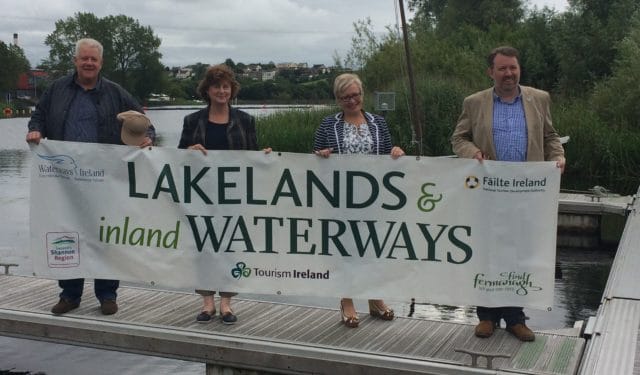
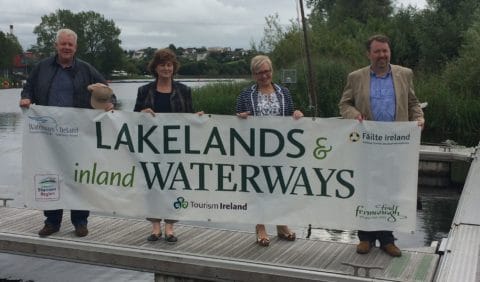
Heading out to finalise the shortlist of locations on Lough Erne are event organisers Kevin Locke and Paul McAleavey of DCAL Inland Fisheries pictured here with Dawn Livingstone Chief Executive of Sponsor, Waterways Ireland and Tanya Cathcart Fermanagh Lakeland Tourism.
The Lakelands and Inland Waterways World Pairs Angling Championships, Ireland’s most prestigious coarse angling event takes place in 3 weeks from 6 September with over 100 entries already registered. The event attracts anglers worldwide to undertake the challenge of catching natural wild fish that are so prolific in Ireland’s Lakelands, with the added difficulty of doing so in partnership. Naturally only the best anglers and their partners participate in this challenging event.
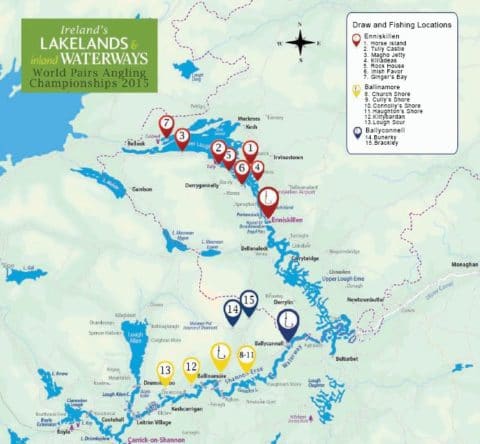
The angling zone for this event is the one hour zone from Killadeas to the North on Lough Erne and Garadice on the Shannon-Erne Waterway in Leitrim in the South. Running the event across the border is an important feature of the competition for the sponsors Lakelands & Inland Waterways, the tourism brand owned by Fáilte Ireland and Waterways Ireland. The excellence of the angling venues is ideal for the event, but it is their close proximity of max 30 minutes drive to the peg from the draw location which allows this partner event to work.
Heading out to finalise the shortlist of locations on Lough Erne are event organisers Kevin Locke and Paul McAleavey of DCAL Inland Fisheries pictured here with Dawn Livingstone Chief Executive of Sponsor, Waterways Ireland and Tanya Cathcart Fermanagh Lakeland Tourism.
Failte Ireland and Waterways Ireland continue to sponsor the World Pairs in providing the top prizes with further support from Fermanagh-Omagh District Council, Leitrim County Council &Cavan County Council. The event wouldn’t work, however, without the active support of DCAL Inland Fisheries and Inland Fisheries Ireland, IFI who resource the preparation of the pegs, the bio-security measures and the stewarding for the events.
Éanna Rowe Co-Chair of Lakelands & Inland Waterways stated “the Lakeland & Inland Waterways World Pairs has shone a spotlight on the high quality and large quantity of wild fish challenging all anglers coming to Ireland’s Lakelands. The competition has sparked a huge level of international interest and it is wonderful to see that reflected in the number of competitions now taking place in the Lakelands and the number of anglers travelling from abroad to participate”
Entry is still open – just find a partner and contact [email protected] to participate in fabulous fishing in the scenic Lakelands including some new areas, not previously accessible. DCAL have again provided a special license valid from 5th-19th September for competitors registered before 28th August.
The Top prize of €10k and second prize of €5k are at the top of a full range of prizes including the DAIWA Cup, an individual entry competition running inside the Pairs with a full entry payout providing cash for 5 peg sections, daily by county and a top ten overall topped up by a massive £8,500 in tackle vouchers from DAIWA Sports Ltd.