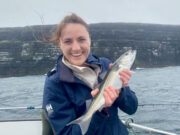
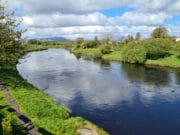
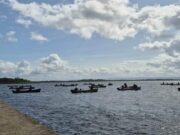
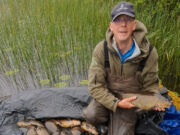
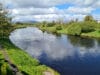
Melvin was fairly quiet over the week. The last 4 days of the season were busier however as The Garrison & Lough Melvin Anglers hosted their 38th Lough Melvin Open Trout Angling Championships. This is a 4 day pairs competition with the Thursday, Friday & Saturday being the qualifying days with the final fished on Sunday.
300 rods fished the competition. The fishing was fairly hard with only 315 trout recorded for the 4 days. There were many Sonaghan caught but most of these did not reach the 11 inch limit.
The competition was won by Cork men P.J O’Brien and Oliver Dillon with 2 trout the best of which was 3¾lb. P.J also recorded the best trout of the competition catching a 7lb 5oz trout during his qualification on Friday! In 2nd place were Basil Shields, Oughterard and Matt Fahey with 6 fish and in 3rd place were Sean Maguire, Garrison and Johnathon B. Craven, Athlone, with 4 fish.
For info/Guides/boat hire on Lough Melvin contact Sean Maguire’s Tackle Shop, Main Street, Garrison. Tel: 0044 7871443304
For bookings/guides etc on the Rossinver Fishery contact Bill McNeary, Tel: 071 9854930 or Jim Hoye, Tel: 0831197428
For info see http://www.rossinverfishery.com/
Sean Jordan, of Bass Fishing Wexford, reports that Italian duo Nick, & Matt enjoyed some decent sport on their few days in South Wexford recently over the last set of decent tides…
Nick with a bass
Matt who is a very experienced freshwater angler was keen to catch his first Bass. Nick told me that he fishes with Matt a lot, and that Matt was the luckiest angler he’d ever known, but after he lost four bass on their first morning I was beginning to doubt him….
Bass – #CPRsavesfish
We were back out on the evening tide looking for some action with surface lures, & sure enough it wasn’t long before Matt’s good luck returned big time, a 75cm Bass, off the surface, after a few “searing” runs the Bass was under control.
75cm bass – lucky Matt
A quick measure, tag, photo, held in the water to recover, & released…. “I told you Sean, he’s the luckiest” said Nick, I have to agree not many anglers get a 75cm, off the surface as their first Bass.
Inland Fisheries Ireland disappointed by findings of new EPA water quality report
Following the publication of the Environmental Protection Agency (EPA) water quality review today, which has been making headlines in the national media, Inland Fisheries Ireland has expressed its disappointment at the findings.
“From an ecological and angling-tourism perspective, our rivers and lakes are vital national resources”, said Dr Ciaran Byrne, CEO of Inland Fisheries Ireland. “It is essential that we protect and conserve these assets and water quality has a significant impact on fisheries habitats and populations.”
The agency has cautioned against singling out any particular sector for the standard in water quality across Ireland’s river basins and lakes, backing the EPA’s findings that ‘multiple factors’ are at play.
According to the EPA report, the total number of reported fish kills in 2013–2015 was 97, an increase in fish kills compared to 2007–2009 and 2010–2012. In several instances of fish kills, the exact cause was unknown and several influences may have played a part.
“There were 31 separate fish kills across the country last year,” added Dr Ciaran Byrne, “but just eight of those were directly attributable to agricultural activities. Inland Fisheries Ireland is grateful to the farming community for their continued consideration and vigilance. Good farmyard management can help to prevent accidental runs of polluting substances and protect the local environment.”
In addition to the agricultural related kills, two fish kills were as a result of municipal works and one by industrial works. In four instances, the exact cause of the fish kill was difficult to ascertain while 16 incidents of fish kills were as a result of disease and natural causes.
Hotline
The organisation also has a confidential hotline number to enable members of the general public to report incidents of water pollution, fish kills and illegal fishing – 0818 34 74 24 or 0818 FISH 24.
Angling guide Christopher Defillion reports from his guiding trips to the Boyne earlier this month:
The Boyne is on fire!
In the early part of the month we had some very good rain, you could say a proper ‘Irish summer’ and the daily showers helped to keep the water levels up and the fresh salmon running… There was plenty of movement also from the coloured fish but of course they dont give themselves up as easy as their fresh silver brothers. My first customers of the month came from Ireland and they were hoping to catch some fresh fish on the fly. We had plenty of action with many hooked and many lost (but thats salmon fishing), until one finally decided to take the fly properly and put up a super fight on the flyrod.
My next clients travelled over from Switzerland to chase this magical fish in the Boyne. Initially the weather conditions were not great, very bright and sunny but the guys kept casting as you never know when a take will come… The second day of their trip the weather conditions were perfect, big thick grey clouds with a few good showers….then the magic happened and we were hooked into a beautiful salmon. It put up a crazy fight running between the weeds and rocks but at the end we managed to bring her to the net. My client was mesmerised at the size of the fish he had caught and the fight that his first salmon gave and after a few quick photos with shaking legs he let the fish swim away. The Boyne had made his Irish dream come true this day.
Happy angler = happy guide
That week was not the only “first salmon” of the week as I also helped a female angler to catch her first salmon as well. This fish was a coloured one, allready a few weeks in the river, but was a very strong fish of a good size and powerfull fight, providing another great memory with screeming reels.
A first ever salmon…
Another afternoon I was also out fishing myself and caught a mixture of coloured and freshly run salmon too.
Nice to see that the water in perfect level and plenty of salmon in the pools in the Boyne for this season.
The Department of Culture, Heritage and the Gaeltacht has urged all water users to take precautions to stop the spread of crayfish plague after confirmation of an outbreak on the Lorrha River in North Tipperary. Numbers of dead freshwater crayfish were reported on the river in Lorrha village earlier this month and DNA analysis has now confirmed that the cause of death was Crayfish Plague.
Fourth outbreak in two years
This is the fourth confirmed outbreak of crayfish plague since 2015. The earlier outbreaks affected the Bruskey/Erne River in Co Cavan, the River Suir downstream of Clonmel and the River Deel downstream of Newcastle West.
The worrying situation is being investigated by the National Parks and Wildlife Service (NPWS) of the Department of Culture, Heritage and the Gaeltacht, Inland Fisheries Ireland (IFI), the Marine Institute, and Tipperary County Council.
The kill has impacted White-clawed Crayfish only. Other freshwater animals are not affected. This is a characteristic feature of the disease which only infects species of crayfish but causes 100% mortality.
Different strain of disease
There is no indication at this stage of how the disease reached the Lorrha River. It is however known that the outbreak on the Suir involved a different strain of the disease to that in the Cavan outbreak. Samples from the Lorrha River are being tested to determine which strain has caused the outbreak of the disease.
All the agencies involved in managing and protecting the rivers in Ireland have expressed concern that another outbreak has been detected and are reiterating their advice and guidance to all users of the river to implement routine cleaning and drying of their equipment once they leave the river and before using it again. This is especially important as it is known that the crayfish plague organism can be carried on wet equipment to new sites. Containment of the outbreak is essential to prevent spread to other as yet unaffected populations in Ireland.
Observe the Check, Clean and Dry protocol
Anyone using the river is being urged to observe the Check, Clean and Dry protocol. All wet gear should be checked for any silt or mud, plant material or animals. It then should be cleaned and finally dried. Disinfectant or hot water (over 60⁰C) should be used to clean all equipment followed by a 24hr drying period. This should be adopted as standard practice in all freshwaters. Drying is especially important, including removing of any water from inside a boat and disposing of it on grass. A drying period of at least 24 hours is needed to ensure that a boat is clear of infectious organism.
Alerting the authorities
People are also asked to alert the authorities of any mass mortality of crayfish or sightings of unusual crayfish that might be non-native species (e.g. crayfish with red claws, large size).
The White-clawed Crayfish is a globally threatened species and Ireland holds one of the largest surviving population. It is the only freshwater crayfish species found in Ireland and is present in lakes, rivers and streams over much of the island. Throughout its European range, this species has been decimated by the impact of Crayfish Plague which spread to Europe with the introduction of North American species of crayfish. Until 2015, Ireland was considered free of the disease and it remains the only European country without any established non-native crayfish species.
Deliberately release is illegal
Many American crayfish species are resistant to Crayfish Plague, but can act as carriers of the disease which is rapidly fatal when passed to the White-clawed Crayfish. The combined impact of the introduced crayfish species (which may out-compete the smaller native crayfish) and Crayfish Plague have completely eliminated the White-clawed Crayfish from much of its European range, leaving Ireland as the last stronghold of the species. The species is protected under Irish Law and the EU Habitats Directive.
It is illegal to deliberately release any non-native species of crayfish into Irish freshwaters.
Severe impact
If Crayfish Plague becomes established there is a high probability that the White-clawed Crayfish will be eliminated from much of the island. Furthermore, if non-native crayfish are found to be established in Ireland, this could have a severe impact on habitats (e.g. destabilising canal and river banks by burrowing) and other freshwater species, such as salmon and trout fisheries.
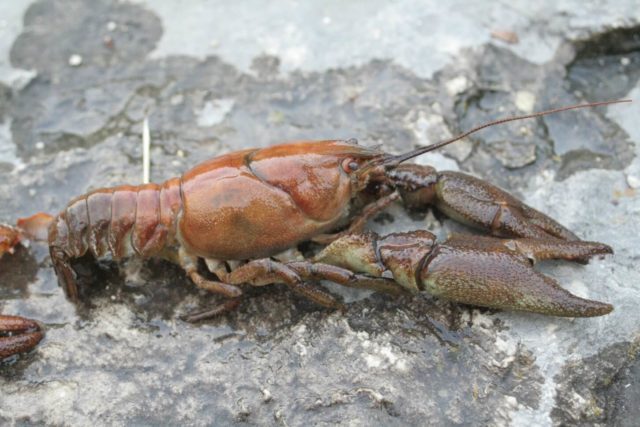
A White-clawed Crayfish. Photo: D. Gerke
However there is no evidence to date that non-native freshwater crayfish have been introduced to Ireland.
Jason Nash reports on the fishing on the River Bandon…
27 August: A decent flood at last graced the Bandon this week and got some fish moving throughout the system. There were some mixed reports from anglers, as is usual in August when salmon are notoriously fickle, but highlights included one angler catching six fish for his day’s fishing, tide fresh grilse being observed running and caught plus one fine fish of 16lbs was released by day ticket visitor John Kenny whilst fishing shrimp.
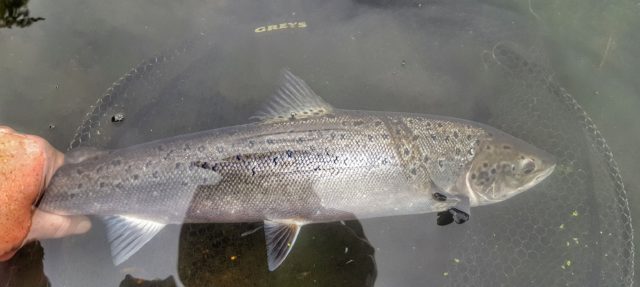
A bandon salmon ready to go back #CPRsavesfish
Please remember shrimp/prawn fishing is prohibited throughout the Bandon river for September and worm fishing is prohibited on club waters.
Fingers crossed for more good fishing in September and an appreciable run of fresh fish
Go Fishing…
Bandon Angling Association have set up a guiding service in conjunction with Jason Nash, Peter Aspinwall and Phil Dewey. Details of the guiding service are provided on the website and they are looking forward to making memories and enhancing people’s fishing experiences on the river Bandon. Day tickets and club membership are also available. Web: https://bandonangling.com/
Kilcoleman Fishery, Enniskeane, is renowned for its hospitality. The owners David and Patricia Lamb make a particular effort to make their guests feel at home. Past visitors have described the atmosphere as ‘laid back’ and the accommodations as ‘cosy’. Kilcoleman is “fly only” throughout the entire season. However, in certain water conditions, spinning is permitted for salmon. Trout angling is “fly only” at all times. web:http://flyfishing-ireland.com
26 August: As is often the case with August there are plenty of salmon in the system but they become more challenging from an angling perspective. Conditions have been good with plenty of water and levels rarely fell below 40 in the last couple of weeks.
First fish landed since my last update was a first ever salmon for Michael Hanewinkel from Germany, who had a 3lbs 1oz fish from the Grilse Pool on a Willie Gunn. Michael then doubled his salmon tally the following day when he landed a nice grilse of 5lbs from the Turn Pool, again on a Willie Gunn. To make it a real family affair, his wife Katarina then landed her first ever salmon, a fish of 4lbs 3ozs on a Black Nymph also from the Turn Pool.
Urs also kept his run going with a fine fish of 6lbs 15ozs from the Stream on Finlough on the 13th on a Delphi Collie and also had one on the 15th from the Stream of approx. 4lbs on a Delphi Collie. Interestingly both of these fish were caught in the last half hour of daylight, when all had been quiet beforehand. Danny McLaughlin from Westport did well for his days fishing landing a fish of 3lbs from Quarry Flats on a Shrimp Fly. Dioni Roberts from Scotland had a fish of approx. 3lbs from the Grilse Pool on the 17th and Urs had his 7th and final fish of his stay that evening, of 3lbs 1oz from the Meadow Pool on an Allie Shrimp. The fish was sea liced but slightly coloured, so possibly one that had been in and out on the tide.
We then had the Hugh Brennan week, even though there were other people fishing it was Hugh or his family that the Salmon Gods shone on. Hugh landed five fish, all on Collie Dogs, two from the river, two from Finlough and one from Doolough. Both fish from Finlough were from the Stream, of 4lbs and 4lbs 6ozs respectively, the latter was again in the last half hour of daylight. His river fish were both on the 22nd, the day after a big flood from the Turn and Quarry Pools and weighing in at 4lbs7ozs and 2lbs respectively. His fifth fish was taken from the Powder House Beach on Doolough and was approx. 4lbs.
Hugh’s daughter Ciara and son in law Kieran Doyle also got in on the act, both landing their first ever salmon. Both fish were taken in Sligo Bay on Finlough on a Delphi Collie and weighed 6lbs7ozs and 4lbs2ozs respectively. Needless to say all involved were over the moon, as it is always a special occasion when one lands your first ever salmon.
The river is still at 60, so conditions are still ideal although I think there are a few fine days coming which might do the fish and definitely the people living here no harm at all!
At Delphi Lodge, with many years of experience with the timing of the best runs of fish, we have in place a price system that offers both great value fishing and lets our anglers know when they have the best chance to catch a fresh run spring salmon or a summer grilse or Delphi sea trout.
John Fleming was on to report more brilliant sharking in Galway:
“We had Dermot Kavanagh and his group out last week, we had 3 blues and a porbeagle shark to the boat.
The first fish fell to Joe – a porbeagle around 40lbs, it’s great to see so many small fish around,a fantastic sign for the future.
A small porbeagle shark caught aboard the Brazen Hussy II
Next up was Dermot with a nice blue around 60 lbs and he had a second fish around 80lb soon later.
A nice blue shark from Galway Bay
The next fish was for Brandon, a fish 2 cm short of specimen size, we had this fish headbutting our bait bucket and we literally hand fed it a mackerel flapper! The fish was 105lbs.
All in all a great day and a very happy group.
A fine blue shark of 105lbs, just 2cm short of specimen length, that was caught, tagged and released aboard the Brazen Hussy II
Go fishing…
To book fishing with John aboard the Brazen Hussy II, give him a call on 087 7571320
A regular day is between 9am- 6pm from either Rosaveel, Spiddal or Galway depending on species being sought after. Fishing on the inshore reefs for pollock, cod, ling, wrasse, conger eel and mackerel can be reached in 10 minutes from departure, while our offshore reef marks are within 45 minutes of departure. Our ground fishing for tope, spurdog, ray, bullhuss, turbot, plaice and the giant common skate can all be reached within the hour which ensures the most amount of time is spent fishing.
The shark season usually starts at the end of June and runs into late October, this is the ultimate angling addrenaline rush with these hard fighting blue and porbeagle sharks all being tagged and release safely.
Package deals available
Osgur Grieve reports on the catches and conditions on the Erriff in the last few days; 23rd – 28th August…
Aasleagh falls this morning
On Thursday 24th father and son Ashley and Lewis Matthews fished with us and released a grilse each of 2.5lbs and 3lbs from Nee’s run on beat 6 and the Boat pool on beat 5 using a black and yellow shrimp and a yellow shrimp. Hugh Jameson had a great afternoon releasing 3 grilse of 4lbs., 4.5lbs. and 5.5lbs. from the quarry pool on beat 2 using a Bann special in strong wind and rain, this equalled his tally of 3 for a day earlier on this season.
Pat Errity fished the afternoon on Friday 25th in very high water and released a fine 7lbs salmon and a 1lbs. sea-trout from the Quarry pool on Beat 2 using a Green-butt cascade.
Regular angler Seamus O’Neill had great sport on Saturday 26th releasing 3 grilse of 4lbs., 4.5lbs., and 5lbs. from Tawnyard potholes, school house run and mike’s pool on Beat 3 using a sunray shadow. Later that day Ian McDonnell released a fresh 2.5lbs. grilse from the gauge pool on an orange shrimp fly.
Alexander Mills fished the afternoon of Monday 28th and was rewarded with a 3.25lbs grilse from the school house on beat 3 using a silver shrimp.
At time of writing the river is at 1m and dropping, and with more rain forecast for tomorrow the river should rise again putting a stir on the fish once more.
Make a booking
If you wish to book fishing please call the fishery office on (095) 42382 or email us at [email protected]