

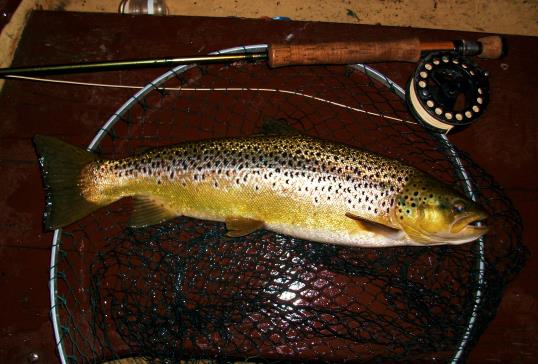
Lough Sheelin Angling Report By Brenda Montgomery, IFI September 19th – September 25th 2016
‘Autumn carries more gold in its pocket then all the other seasons’
Jim Bishop

Just after sunrise, Kilnahard, Lough Sheelin September 18th
Lough Sheelin in all its fickle and unpredictable beauty spreads over 1820 hectares, not a big lake by any standards when compared to the great Western lakes of Conn, Corrib and Mask but Lough Sheelin seems big when you are an angler standing on the shore of this seemingly large stillwater impoundment, lacking in confidence, wrapped in the first chill of autumn, at the very back end of a fishing season and wondering if there is a trout within rifle shot never mind a moderate cast.
Lough Sheelin dispelled all those doubts about its trout stocks as each day this week the Sheelin trout put on an impressive and continuous display of aerial acrobatics all over the lake – nose diving the air, spirals of silver and flashes of gold, piscatorial arcs of wild abandonment and on some occasions leaping that close to the boat one would think that with a little bit of encouragement they might actually land in our laps.
Even though it happens year after year, the arrival of autumn always seems to come as an unwelcome jolt. It is almost as if a switch is suddenly turned on and we are caught unawares by this change of seasons. We can thank the autumn equinox this week for that shift from the previous warm days of a lingering summer to what the American’s refer to as ‘The Fall’.
The word equinox is a Latin word meaning equal and implies equal daylight and darkness after which there will be a gradual tipping of the balance towards shorter days and the encroaching blackness of night, another reminder of the fast approaching close to the trout season here.
There is something special about an equinox in that unlike an event like New Year’s midnight that follows the clock around the time zones, equinoxes happen at the same moment everywhere in the world – not just at Lough Sheelin.
On a few mornings this week we were treated to chilly temperatures and that magical appearance of millions of intrinsically designed cobwebs embroidered over shoreline bushes like tents of fine gauze.
This year the autumn equinox arrived precisely at 10.21am last Thursday, September 22nd and was marked magnificently that morning by the landing of a trout of over 4lbs by Dublin angler Paul Delaney.
The Catches…
For the fly angler with only a few weeks left till the close of play on this lake, fishing now is a little like reading last week’s Sunday Times on Saturday, interesting stuff, but it’s mostly over. Trout feeding habits digress, fish do not come as easily to the fly as they would earlier in the season, their minds seemingly on getting into location to eventually run the rivers to spawn rather than to find dinner.

Paul Lunney winner of the McIntyre/Guider cup with his 3lbs 8oz fish being presented with the cup by Dessie McEntee treasurer of the Cavan Anglers, Saturday September 24th
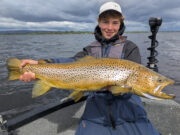
The heaviest fish for this week was a trout of 7 ½ lbs caught by Paul Delaney, Dublin using a Claret Dabbler at the Long Rock
Total number of trout recorded : 42
Selection of the catches
Ned Shannon, Banbridge – 5 trout averaging 2 – 2 ½ lbs caught on wets.
Aleksandrs Trifonous, Navan – 2 trout at 2 and 2 ½ caught on lures.
George Stonehouse, Ross, Lough Sheelin – 3 trout, heaviest at 2½ lbs caught on Silver Daddies and Dabblers.
Pat Brady, Cavan – 3 trout, heaviest at 3lbs caught mid lake on Bibios and Silver Invictas.
Michael O’Neill, Cork – 2 trout heaviest at 2 ½ caught using Stimulators and Golden Olive Bumbles.
Please remember All anglers are required to have a Fishery Permit to fish Lough Sheelin which must be purchased BEFORE going out on the lake.

Competitions…
On Sunday October 2nd Lough Sheelin’s angling club The Lough Sheelin Trout Protection Association will host their annual Stream Rehabilitation Competition starting at Kilnahard from 11am to 6.0pm.
All proceeds of this event go towards the enhancement and rehabilitation of the rivers within the Lough Sheelin catchment.
The club and organisers of this competition, now in its eleventh year, welcome all anglers who wish to fish one of the best wild brown trout fisheries in Ireland and to experience first-hand the magic and allure of this lake which has the potential to produce the heaviest trout in the country.
For details please contact Eamonn Ross @ 086 6619834/ 049 9526602 or Thomas Lynch @ 087 9132033
Click on the Link for a copy of the Entry form for Lough Sheelin Trout Protection Association Stream Enhancement Competition
http://www.loughsheelinanglers.ie/

The Cavan/Monaghan Garda Divisional Fly Fishing Championship and Open Competition will be held at Lough Sheelin on Sunday October 9th from Kilnahard Pier, 11a.m – 5.30p.m.
Weigh in will be at 6p.m sharp at Crover House Hotel.
This competition is for: The Heaviest fish – visitors and The Heaviest fish – Cavan/Monaghan Division Garda Members.
For further details please contact Dessie McEntee on 047 77216 or 086-8937568
Please remember anglers to abide by BYE-LAW 790 which strictly prohibits
• All trolling on the lake from March 1st to April 30th (inclusive).
• From May 1st to June 15th – no trolling between 7pm –6am and no trolling under engine between 6am – 7pm and
• June 16th – October 12th – no trolling under engine between 7pm – 6am.
• No trout less than 14 inches should be taken from the lake
Please remember anglers to abide by BYE-LAW 790 which strictly prohibits
• All trolling on the lake from March 1st to April 30th (inclusive).
• From May 1st to June 15th – no trolling between 7pm –6am and no trolling under engine between 6am – 7pm and
• June 16th – October 12th – no trolling under engine between 7pm – 6am.
• No trout less than 14 inches should be taken from the lake
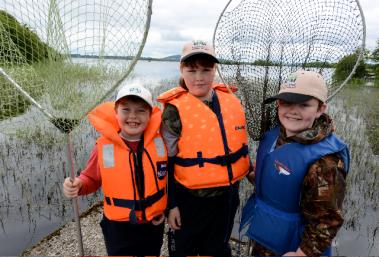
It won’t work if you aren’t wearing it…
Water rarely gives second chances and a life jacket is just that – it saves your life, so we would implore anglers and all other users for their own safety as well as it being the law under
SI No 921 of 2005 – Pleasure Craft (Personal Flotation Devices and Operation) (Safety) Regulations 2005

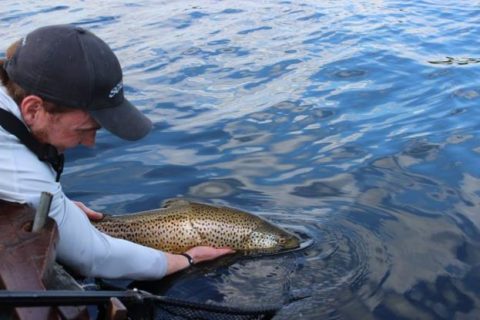
A catch & release policy is actively encouraged on the lake at all times
The Hatches and the Flies…
The trout are not motivated by food and for the angler fishing this lake it’s all about luck. Fly life is considerably reduced in September and what is available now is confined to some good hatches of olives on warm, stable days with light or calm winds on the lee side of Church Island and down into Bog Bay and Rusheen where dry Olive Emergers (size 18) worked like a dream when the weather behaved itself. The terrestrials are still there, albeit in small numbers and only along very sheltered areas and tight to shorelines. Beetles and Daddies undoubtedly pose an irrestible snack to trout so when nothing is happening, a beetle is a far better fly for prospecting when no fish are rising than the typical Dabbler or Humpy. A patterned beetle should be one with a red spot on it, as plain black beetles are nearly impossible to follow on the water. Lacking a beetle, small Elk Hair Caddis or Stimulators can be effective searching patterns, as they look like hoppers or other large terrestrial insects.
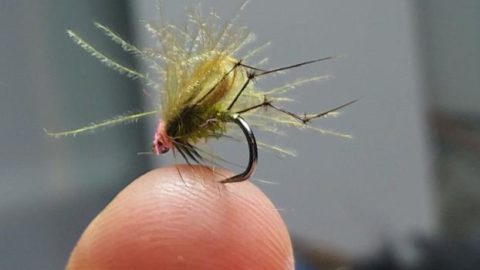
Hopper (Richy Anthony)
A steady number of anglers fished Lough Sheelin this week, undeterred by some days of difficult weather conditions – continuous rain and strong South westerly winds which forced them from the middle of the lake to more sheltered areas.
There were a number of good catches recorded mostly on teams of wets, the favourites of Bumbles, Humpys, Bibios, Silver Invictas, Dabblers and Olive patterns on Intermediate lines still coming up trumps for anglers. The use of lures, streamers and larger imitations like the Minkie’s and Humungus on sinking lines resulted in some heavier fish. With the persistent inclement weather dry flies were forced to take a back seat but with the weight of the week at 7 ½ lbs caught on a Claret Dabbler, the ‘fly’ flag is still flying high on Lough Sheelin.
Many anglers at this time of the year specifically pursue Lough Sheelin’s reputed ‘heavy weights’ searching along certain shallows, near the mouth of bays into which a spawning river enters, around certain islands, along stony shallow shorelines and off rocky points or promontories. Flies like the Dabblers in Claret, Silver, Olive and Ginger or those flies with tinsel bodies like the Invicta were dragged through the water in the hope of enticing with movement and colour, those large fish, a method that proved successful with our Dublin angler striking gold with his 7 ½ pounder on a Claret Dabbler.
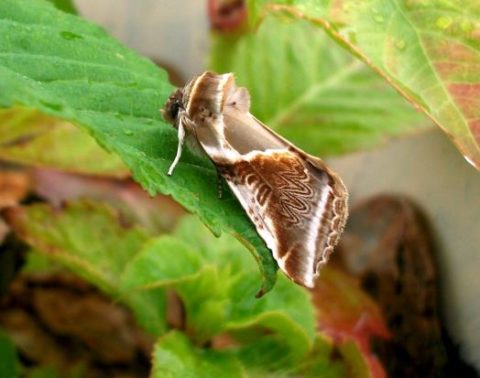
Buff Arches moth at Crover, Lough Sheelin
For those who just enjoyed some decent fishing it was all about heading for open water and locating and targeting the daphnia feeding pods of trout. With higher temperatures and decreasing light levels as the sun is now at the equinox, the daphnia blanket consistently moves higher in the water and hence so do the trout. Possibly because they feel vulnerable swimming round in open water, daphnia-feeding trout tend to move about in shoals, and range in size from ¾ to about 2 ½ lbs so are not contenders for that elusive specimen weight. There are a number of Sheelin anglers who ear mark September as being their time for some real fishing on Sheelin and are avid Daphnia fans. Daphnia, microscopic organisms, that are near on impossible to imitate are really the only significant food source out in the depths. In concentration they have an orange colour and although teams of three using Stimulators and brightly coloured flies as well as nymphs and imitative designs have landed fish, the most productive fly, without flash or complex construction was the orange booby (apologies to all those fly purist out there) confirmed by the landing of twelve trout in the one day by Northern Ireland angler Stan McGorty, all ranging from 1 – 2lbs.
Both movement and colour seem to be important at this stage of the fishing season. The old tried and tested patterns are the best and the fly pattern that is still doing consistently well on this lake are the Dabblers – Claret, Olive, Silver, Sooty, Pearly, Ginger and Peter Ross. Patterns that worked best were those with longer hackles or wings to produce extra movement and a more streamlined shape.
Minkies and Humungus in black with a twist of silver and Streamers on sinking lines as well as the Orange Booby for the Daphnia addicts.
Other popular flies were the Golden Olive Bumbles, the Klinkhammers, the Muddler Minnows, the Silver Invicta, the Daddies – Detached and in Silver, Gorgeous George, the Humpies, the Stimulators (particularly with a twist of silver in them), the Diawl Bachs, the Bibios, the Muddlers and Wickhams Fancy.
The areas of the lake that featured well were around Church Island, Rusheen, down along Holywell, Wilsons pt, Chambers, the Long Rock and Derrahorn.
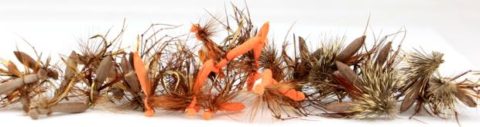
A mixture of Daddies
Next Sunday, October 2nd the LSTPA will host the biggest trout fishing competition of the year on this lake with a previous reputation for attracting over two hundred anglers. This week and over the next number of days many anglers take time out to practice on this water for this event so from now until this competition is over it will be a psychological challenge to find out exactly what flies are working for anglers.
From the anglers that would ‘tell’ and who caught some nice fish during the week, the colour claret is still working well. The fish are still feeding on fry so perch fry imitations can be successful and a fly with silver threaded through it to imitate that flash of silver from the perch fry is usually a good plan. The Dabblers are still high on the agenda with a number of trout being recorded using variations of this pattern. The top dropper is the most important fly to the fish so a Silver Invicta, Detached Daddy or Red Tailed Green Peter might be recommended at this stage in the season. Going back to a quote by John Gierach where basically he says that anything goes if it is used enough and I did notice a vast selection of varying flies being used over the past 7 days with only a vague common ground between them. But remembering angler’s Stevie Munn’s observations in that it is the traditional flies that have always worked best on Sheelin, my advice would be to go for the tried and tested flies that have been used here for the past 50 or so years, we are talking about the Sweeny Todd, all the Dabblers (particularly Claret and Silver), the Peter Ross (on the point, good for when the trout are feeding on the fry), the Claret George, Green George, Klinkhammers, Stimulators, Detached Daddies, Fiery Browns, the strong attractor patterns like the Butcher and Bloody Butcher which are fantastic flies to use when fish are on the fry with their silver bodies and dark wing, the Sooty Olive, the Alexandra and the Dunkeld.
The Zulu is a very effective pattern and although not that commonly used on Sheelin can be an excellent fly when fished in a team of flies, on the top dropper.
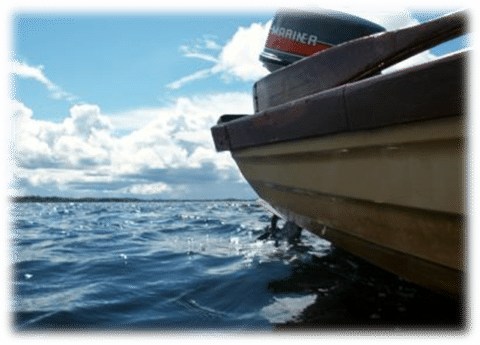 Reading the above reminds me of trying to pick out the winning horse for the Grand National, where each fly has its own merits but there is such as vast selection it can all get a little overwhelming and you have a tendency to jump from one to another. Another piece of advice from the Sheelin experts that might be worth remembering is that if a fly hasn’t moved anything for 20 minutes then it’s time to change to another – just a suggestion.
Lough Sheelin’s Midland Fisheries Funded Project
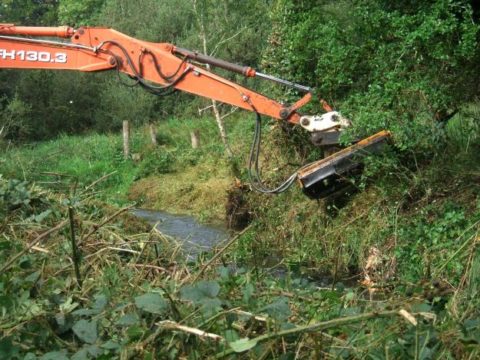
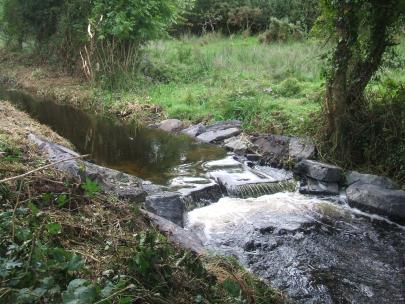
The local Sheelin angling club – The LSTPA applied for and were successfully awarded funding from MFF earlier this year, their submission being to rehabilitate and enhance a1000 metre stretch of water on the upper reaches of the Mountnugent River. The Mountnugent River is one of the main trout spawning rivers within the Lough Sheelin catchment. This week saw the completion of this work which included the removal of trees, shrubs and vegetation, the introduction of weirs and spawning gravel, bank protection, cattle drinkers and fencing.
This rehabilitation work will undoubtedly bring more trout further up this river system to spawn and will increase juvenile numbers considerably. Although we might not be able to revert to times gone by when one elderly farmer informed us that when he was a little lad ‘you used to be able to cross that river on the backs of the trout’ this work will have a very positive effect on the trout numbers within Lough Sheelin and its catchment.
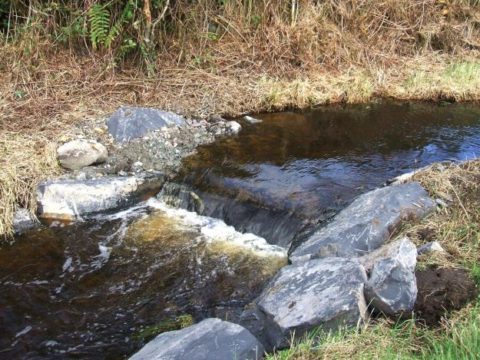
One of the many weir constructed on the Mountnugent River
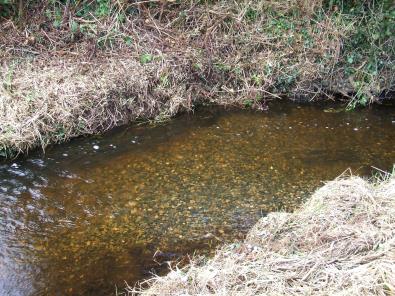 Spawning gravel
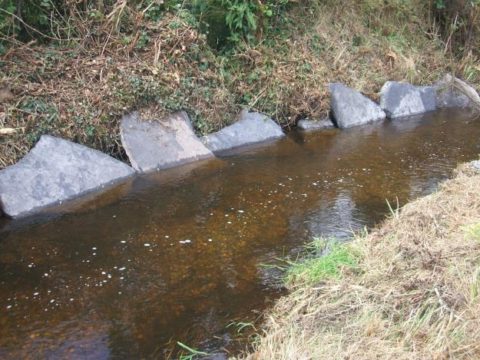
Bank protection to prevent future erosive
Before – opening out the Mountnugent river downstream of Rassan Bridge…
After – Weir construction & bank protection…
A look around Sheelin…
Brenda Montgomery IFI