Crayfish Plague is endangering the River Suir species in Kilkenny
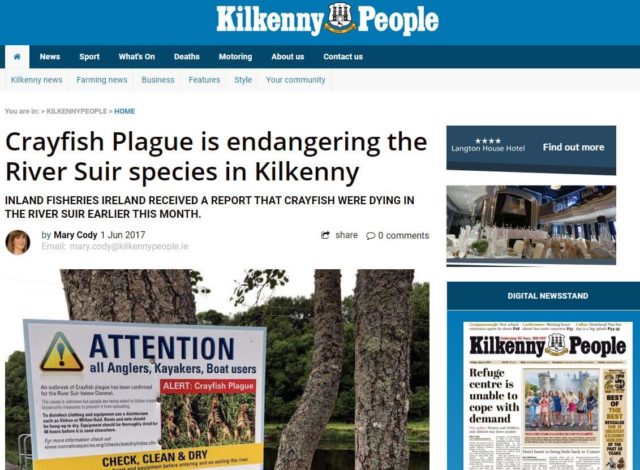
An outbreak of Crayfish Plague on the River Suir is the single greatest threat to Ireland’s native white-clawed Crayfish populations, which are the most significant in Europe. A meeting of Interagency personnel from the National Parks and Wildlife Service, Inland Fisheries Ireland, along with other experts to discuss the most appropriate response to the outbreak took place this week… Kilkenny People, 01/06/17. Read the full article ‘Crayfish Plague is endangering the River Suir species in Kilkenny‘.
Crayfish Plague is endangering the River Suir species in Kilkenny
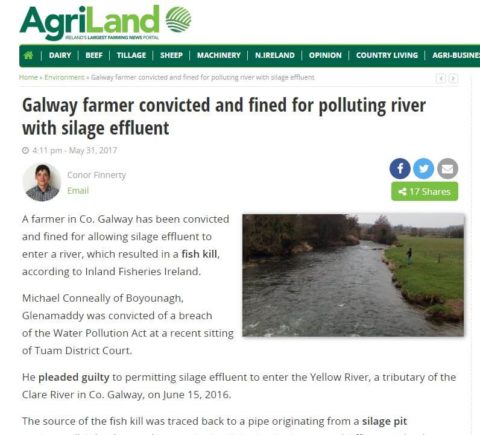
A farmer in Co. Galway has been convicted and fined for allowing silage effluent to enter a river, which resulted in a fish kill, according to Inland Fisheries Ireland. Michael Conneally of Boyounagh, Glenamaddy was convicted of a breach of the Water Pollution Act at a recent sitting of Tuam District Court… AgriLand, 31/05/17. Read the full article ‘Galway farmer convicted and fined for polluting river with silage effluent‘.
Galway farmer convicted and fined for polluting river with silage effluent
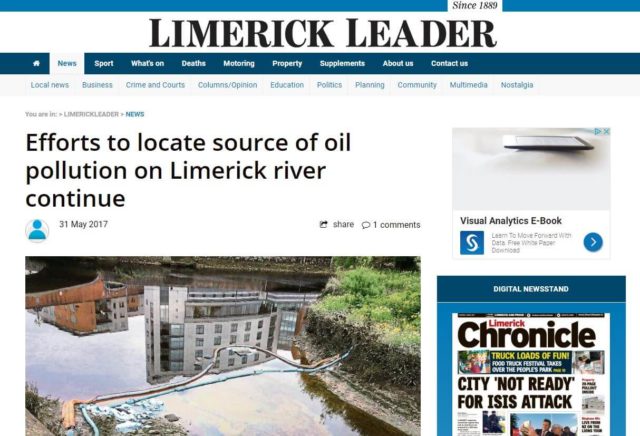
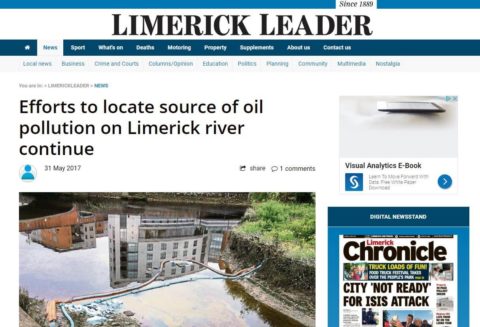
Efforts to locate source of oil pollution on Limerick river continue
Limerick City and County Council says efforts are continuing to identify the source of an oil spill on the Abbey River. A boom and highly absorbent oleophilic pads have contained the worst of the pollution on the Abbey River at its confluence with the Park Canal. Officials from Limerick City and County Council along with Inland Fisheries Ireland have been monitoring the situation since being alerted on Tuesday afternoon… Limerick Leader, 31/05/17. Read the full article ‘Efforts to locate source of oil pollution on Limerick river continue‘.
Efforts to locate source of oil pollution on Limerick river continue
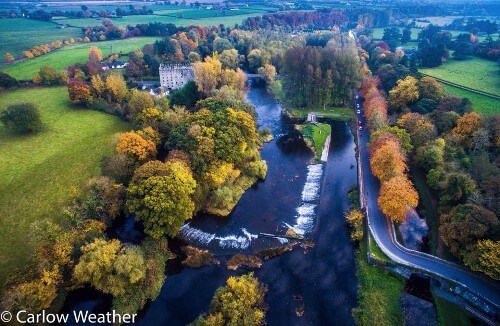
Aerial image of the River Barrow, courtesy of Carlow Weather.
New research reveals current state of fish stocks in Ireland’s second longest river
River Barrow water sites have 39% high or good fish status
14 fish species and one hybrid species identified
New research from Inland Fisheries Ireland has revealed the state of fish stock levels and the different species present within the River Barrow catchment. The River Barrow is Ireland’s second longest river after the River Shannon and this is the first large scale catchment wide survey undertaken in the River Barrow to assess the status of all fish species present. The report reveals that 39% of water sites surveyed on the catchment had high or good fish status.
The ecological fish classification status of various sites was calculated as part of the survey to assist with future fisheries management plans. This included assessment of 35 of the River Barrow’s main channel sites and a further 83 sites within the river’s sub catchments. Overall, ‘High’ fish status was recorded on five per cent of sites and ‘Good’ Fish was assigned to 34% of sites. The positive fish status was recorded in the upper reaches of the River Barrow main channel above Mountmellick, County Laois, downstream of weirs where flow and habitat conditions were more favourable for a larger range of fish species and generally in the middle and lower subcatchment river systems.
Aerial image of the River Barrow, courtesy of Carlow Weather.
However, more than 60% of the sites were cited as moderate fish status or less. The main reasons for less than good fish status were poor water quality, poor habitat, the presence of artificial barriers impeding migratory fish passage and possible competition from the invasive dace species. Further investigation of these sites will be required prior to the implementation of mitigation measures such as improvements to water quality, habitat enhancement works to improve spawning and nursery areas or tree planting to provide cover for fish.
In addition to classifying the fish status of the sites, the species of fish present were audited as part of the research. More than 10,000 fish were caught and released as part of the survey with a total of 14 fish species and one hybrid (mix) species identified. Dace, an invasive fish species, was the commonest species in the main channel sites, followed by roach, perch and juvenile salmon, while salmon and brown trout were the commonest species in the subcatchment rivers. Pike were found in 54% of the main channel sites surveyed and brown trout were recorded at 45% of these sites. Other fish species logged included minnow, gudgeon, eel, stone loach, 3-spined stickleback and flounder as well as roach-bream hybrids.
Inland Fisheries Ireland staff electrofish the River Barrow as part of the research.
Dr Fiona Kelly, Senior Research Officer at Inland Fisheries Ireland said: “This survey is the first of its kind within this large catchment area and it tells us a great deal about what is happening on these sites. It is evident that we have an abundance of different types of wild fish species present; however we also know that there are challenges for the catchment in terms of water quality, habitat and invasive species which will need to be addressed. Ultimately, this research will inform future fisheries management and protection strategies.”
Inland Fisheries Ireland encourages all stakeholders on the River Barrow to support the conservation and protection of the river, its tributaries and the species contained within it. It is also hoped that community groups will consider what they can do to improve its water quality and ecology and create a healthy water environment for the benefit of all users.
To view the full report, visit: http://www.fisheriesireland.ie/fisheries-research-1/1417-fish-stock-assessment-of-the-river-barrow-catchment-2015 .
Shane O’Reilly, Dublin in the mid day heat on Lough Sheelin
“If I fished only to capture fish, my fishing trips would have ended long ago.” Zane Grey
Mayfly on Mayblossom
Now into the third week of the mayfly season here on Lough Sheelin and with the month of May now behind us, this lake lived up to its reputation as being a punishing, inflexible and grueling stretch of water to fish, particularly during the day. The general consensus for this week was that any trout caught here were hard earned.
There were plenty of anglers fishing during the week, with our visiting anglers being mainly from Northern Ireland, England, Scotland, Wales, Belgium and France with two Russian anglers introducing Sheelin for the first time into the eastern bloc of Europe.
Christopher Defillon with David Gauduchon, France
Despite good numbers out fishing the lake, returns were poor verging on abysmal during the day with Sheelin only redeeming itself somewhat in the evening and beyond night fall when the spent gnat fishing turned up feeding fish. The trout seemed to be taking the spent more as the week progressed into the weekend.
Pulled in
‘Fishing is called fishing and not catching’ – a well coined expression from the seasoned hard core Sheelin anglers who take this lake in their stride, embracing the bad days as well as the good and seemingly secure and totally accepting in the knowledge that this is a moody lake that never gave its fish up easily.
Darragh Browne, Dublin happy out with his nocturnal fish
The Hatches
Dancing spent at Merry Point
Lough Sheelin for this week produced the goods as far as mayfly hatches were concerned, with impressive swarms preforming graceful aerial dances on par to an extract from the 1963 Hitchcock film ‘The Birds’ and with impressive falls of spent, like snowflakes, spreading out like some elaborately designed carpet stretching out across the water as far as the eye could see.
Cathal McNaughton, Antrim with a 3lb 3oz trout caught at Wilsons Pt. on a Spent Gnat
Putting fishing to one side for a moment, anyone who ventured out on Lough Sheelin this week witnessed one of the most amazing fetes of nature out on this water and that is the life cycle of the spectacular mayfly – Ephemera danica, the presence of which is a very reassuring reminder that the ecology of this lake is healthy because the nymph of this insect would simply not survive in a polluted environment.
Paul O’Reilly, Dublin with his Spent Gnat trout
These majestic and beautiful insects form a very vital matrix to this wonderful wild brown trout fishery that is Lough Sheelin. Mayflies are unique to other insects in that they go through incomplete metamorphosis, going from egg to nymph to adult, and lacking the usual intermediate pupal stage, they are the only insect to have two winged adult life stages a subimago and an imago. Moulting or emerging of mayfly nymphs happens when the water gets that bit warmer or during the mornings or evenings in the summertime. When mayfly nymphs start molting, air and gases collect under their protective shell, increasing their buoyancy and pushing them to the surface. They start coming out of their exoskeleton either while still subsurface, or when they float to the surface and these are our emergers. Our welsh anglers over the past few days were fond of fishing with mayfly nymphs, in greens, browns and greys and they achieved some successes with these subsurface patterns.
Mayfly
Emerger patterns for anglers covered the surface stage. Des Sherwood from England landed himself a 4 ½ lb fish using a pattern that imitated both a nymph and an emerger – a pale body with a brown tufted head.
The exoskeleton splits along the back and the mayfly pulls itself out and lifts up its wings. The mayfly sits on the surface at this stage (looking for all the world like miniature sailing boats) – not to dry its new wings which is a common presumption but rather they wait for their wings to fill with fluid and their veins to harden. The second molting of the winged adult mayfly is unique in the world of insects. The final transformation is from a dun (sub imago) to a spinner (imago) – with clear intrinsically veined wings, short antennae and large eyes. They have no digestive organs and can neither eat or drink and so after mating die within a few hours. Spinner falls usually happen in either dusk or dawn but there can be earlier falls during the day depending on the weather.
Understanding the life cycle of this most important insect forms an integral and vital part to successful fishing during the mayfly season here.
The Catches
Joe Mcilduff winding down on Crover shore after catching the weight of the week – a 7 pounder on a Spent Gnat on Tuesday night May 30th
This week it was all about sunsets and late evenings, for it was those anglers that fished at these times who dominated the catches of trout for this week.
Lough Sheelin was all about sunsets and darkness for the last week’s May fishing
For this week at least, Lough Sheelin was the definition of conservation during the day time – its trout were safe as the majority of anglers struggled, pulling flies during those office hours, negotiating wind changes and temperature drops ‘4 seasons in two hours and lake fish hate it’ one experienced angler concluded. The weather is of course a contributing factor and so far this mayfly season has not been one which anglers would have wished for.
Shane O’Reilly, Dublin in the mid day heat on Lough Sheelin
It’s an undisputed fact that Lough Sheelin contains a huge stock of trout, anglers are seeing them (and missing them), the fly hatches particularly of mayfly are enormous but the Sheelin fish are simply not interested or motivated to ‘take on’ in any sort of a steady fashion. Takes that do happen seem to be almost half hearted, these fish are just not hungry enough. The best analogy is the one of someone eating a huge meal, you are stuffed to capacity and then someone produces another plate of irrestible food but still you can’t help yourself and you might pick despite being full and this is what it’s like with the fish. They have a huge and varied amount of food subsurface, they don’t need the surface food but still there is a chance they might just try it out. Takes are soft and inconsistent.
‘Releasing’
Regardless of the lack of any serious feeding, beautiful fish were caught this week as well as some heavy weights both seen and lost.
The heaviest fish for this week was a 7lb trout caught by English angler Joe Mcilduff, Northern Ireland using a Spent Gnat pattern, fishing off Crover.
Total number of trout recorded: 123
Selection of Catches
Ned Clinton, Crover – 1 trout at 5lbs 3ozs on a Spent Gnat pattern.
David Palmer, Northern Ireland – 2 trout – 5 lbs on a Spent Gnat and 4 ½ lbs on a Murrough.
Martin McCoy, Northern Ireland – 2 trout – 3 & 5lbs caught on Spent Gnat patterns.
Paddy Lyons, Cavan – 2 trout at 4lbs 10 and 3lbs 12ozs on Spent Gnat patterns.
Brendan Corrigan, Northern Ireland – 10 trout for the week, heaviest at 5 ½ lbs caught on a Spent Gnat pattern off Inchacup Island.
Mark Teller, Northern Ireland – 12 trout for the week, heaviest at 5lbs caught on a Grey Wulff at the back of Church Island. Other weights varied from 2 ½ lbs to 4 ½ lbs.
Andrew Dale, South Wales – 2 trout at 2lbs on Spent Gnat patterns.
Kieron Ward, Navan – 1 at 1 ½ lbs on a Spent Gnat.
John McGovern, Drumcondrath – 2 trout heaviest at 2lbs on Spent Gnat patterns.
Marc Luyten & Chris Vercammen, Belgium – 9 trout heaviest at 3 ½ lbs using Spent Gnat patterns, fishing mid lake and out from Inchacup.
Peter Neeson, Northern Ireland – 2 trout on May 31st, heaviest at 3lbs caught on a black Spent Gnat pattern.
Colm Higgens, Clane – 5 fish up to 5lbs on Spent Gnat patterns.
Owen Jacobs, Dublin – 1 trout at 3 ½ lbs on a black Spent Gnat pattern.
Ben Mckay, Scotland – guided by Lough Sheelin Guiding 6 trout heaviest at over 6lbs, caught on Spent Gnat patterns.
John Mulvanney, Kells – 3 trout heaviest at 3lbs on a Spent Gnat pattern.
The best areas to fish this week were from Gaffney’s Bay, Inchacup and around by the Stony Islands. The biggest falls of spent over the past few days were around this area of the lake, again this is dependent on wind direction. Drifts into Arley and Walkers fished well. Although there is a lot of fish at Wilson’s Pt. this is an area of the lake that does not like boat pressure so even the presence of two or three boats will spook the fish and drive them to down deep. Lynch’s pt. has a reputation for bigger trout but still contradicting this was the weight of the week which was caught along Crover.
Follow the leader
Going forward my advice to any angler intending to fish this lake in the coming week is to stick to the evening time, from 7pm onwards, adjust the choice of area according to the wind direction and use a spent pattern in black with perhaps a small bit of red in the butt of the body.
A quiet corner of Lough Sheelin
The Flies
A beautiful Royal Wulff tied by Kevin Sheridan – this fly fished exceptionally well on Lough Sheelin and generally works for spent fishing here
The most successful flies this week were the Mayfly nymph patterns, wet Mayfly patterns in greens with mixes of brown and white mingled through, the Mosley Mays, the French Partridge, the Goslings, Dennis Moss’s Ginger Mayfly, Soft Hackle Mayfly Emergers, CDC Mayfly Emergers, the Wulffs (grey and royal), the Spent Gnat patterns (a predominance of black worked best). Other patterns catching fish were the Dabblers (Claret, Green and Silver), Stimulators and Bumbles.
Some Emerger patterns
The best combination for day time fishing was an orange Stimulator on the top dropper and a May fly pattern like a French Partridge on the point with a chartreuse coloured fly in the middle, fished on a floating line. Gink up the Stimulator and this will bring up the trout. The Royal Wulff topped the poll for the evening fishing and proved it’s reliably and consistency this week by producing a number of results over the 3lb mark. This is a great fly for spent fishing and ginked up as a top dropper is good for wet fly fishing. There are a number of varieties of Wulffs but Royal, Grey and Black were the best for this week. The yellow Humpy, a Claret Bumble (as a top dropper) and a Golden Olive Bumble got results for day time fishing.
Anglers, for this week tried out a vast and mind boggling array of Mayfly patterns with what seemed to me to be a huge amount of chopping and changing of flies, some sound advice is to stick to one set up and only if the fish are rising and not interested in the flies then change the flies but not before then. A good rule of thumb is to use 8lb strength ultra-green maxima for wet fly or spent fishing and a 6lb strength for day time when fishing the greens.
A catch & release policy is actively encouraged on the lake at all times
All anglers are required to have a Fishery Permit to fish Lough Sheelin which must be purchased before going out on the lake.
Please remember anglers to abide by BYE-LAW 790 which strictly prohibits
All trolling on the lake from March 1st to April 30th (inclusive).
From May 1st to June 15th – no trolling between 7pm –6am and no trolling under engine between 6am – 7pm and
June 16th – October 12th – no trolling under engine between 7pm – 6am.
No trout less than 14 inches should be taken from the lake
Join the Club…
For anyone interested in joining Lough Sheelin’s Angling Club – The Lough Sheelin Trout Protection Association please contact Thomas Lynch @ 087 9132033.
We would implore anglers and all other users to wear life jackets for their own safety as well as it being the law.
Getting it right – Caoimhe & Oisin Sheridan
Life jackets are required by law – SI No 921 of 2005 – Pleasure Craft (Personal Flotation Devices and Operation) (Safety) Regulations 2005.Water rarely gives second chances and a life jacket is just that – it saves your life.
Please put on and keep on that life jacket until you are back on dry land.
Dave Harlow from the UK has been visiting Ireland for 35 years and is back again to take part in the canal festival on the Grand Canal in Prosperous. In a recent practice session Dave produced a nice net of quality bream and tench from the canal at Daingean. Dave hopes that this quality fishing will continue for him during the competition.
‘Into the night’ dusk & darkness were the best times to fish Sheelin for this week
‘Into the night’ dusk & darkness were the best times to fish Sheelin for this week
It was another busy week for anglers in Ireland. The mix of weather was not all bad and there were times when the conditions were just right leading to some very impressive catches for game, coarse and sea anglers…
Salmon anglers on the Moy had their best week of the year landing over 260 fish. the Drowes also fished well with about 40 fish, mostly grilse, caught despite low water. One party of tourist anglers had 12 fish on Saturday. Grilse have provided excellent sport at the Galway Fishery, with 72 fish landed and some anglers getting 3, 4 and 5 fish in a session. In Co. Kerry the Laune had another good week and the Laune Anglers Water produced a couple of fish each day, some grilse but bigger fish are still coming in fresh off the tides.
Despite colossal hatches of Mayfly on Lough Sheelin the fishing was patchy. There were some super fish landed and some good fishing enjoyed but it was far from consistent. Evening’s, dusk and dawn fished best. Caenis hatches have over taken the Mayfly fishing on Corrib. After what proved to be a disappointing Mayfly season on the lake anglers are getting better fishing now – if they can get up early enough. On Lough Mask the changeable weather made for inconsistent fishing. mind you some anglers hit it just right: Local Ballinrobe anglers Tommy Foley and Tim Hannon had a red letter day last week by boating 19 trout on a combination of wets and dries (best fish 2.5lbs; all returned).
Early starts were part of the recipe for success employed by by two anglers from Merseyside fishing with Melview Lodge. When the bream were being tricky they did very well on tench. The bream played ball they caught up to 272lb in a day. Some decent weights were also reported from a number of other venues with catches to 80lb at Shannon Harbour and 40lb at Killykeen. Congratulations go to Shamie Winters for winning the Ballinamore Festival and to Stuart Blunsom for taking the honours in the O’Callaghans Cup on Inniscarra.
Good pike fishing was reported from parts of the Shannon last week. One angler 89 fish over 5 days around Meelick and other anglers did well at Banagher and Pallas Lake. There was also some decent pike fishing reported from a number of Cavan venues.
Sixgill shark
There was more incredible shark fishing news last week as Andy Griffith managed to hook and land 2 1000lb plus six gill sharks while fishing on Luke Aston’s Clare Dragoon out of Carrigaholt in Co. Clare. The sharks were about 14 and 18 feet long and estimated to weigh 1150 and 1400lbs. But the shark news doesn’t stop there. Small boat anglers fishing out of the Bellavista Angling Centre in Cobh had the first reported blue shark of the year. The first blue shark of the year always gets Catch of the Week. But given Andy’s incredible achievement we have to share the honours this week in a rare double Catch of the Week award.
Blue shark in the boat – the first of 2017
Staying with sharks there were some good smoothhounds and pack tope taken from Wicklow. Galway Bay is producing good fishing over reefs with plenty of pollack and coalfish being caught. Tope are also in the mix as are cod.
Crayfish plague – update
All water users are asked to operate a temporary ban on moving water sports and angling equipment out of the River Suir and River Deel catchments – commencing immediately. Water sports and angling equipment currently in use in the Suir and Deel catchments may continue to be used there; but boats or angling equipment should not be transferred out of the catchment. Limit your activity to the river section where you normally operate, avoid moving around the catchment and follow biosecurity protocols – Inspect, Remove, Clean, Dispose, Notify. Anglers: http://www.fisheriesireland.ie/invasive-species-1/358-invasive-species-biosecurity-guidelines-for-anglers-leaflet-1/file
Saturday morning will be dry in the east with sunny spells. Showers in the west will extend eastwards and become widespread by early afternoon. Some will be heavy and a few possibly thundery in Ulster. Highest temperatures of 13 to 17C with moderate to fresh southwest winds. The outlook is for changeable and fresh weather over the rest of the holiday weekend and into next week.
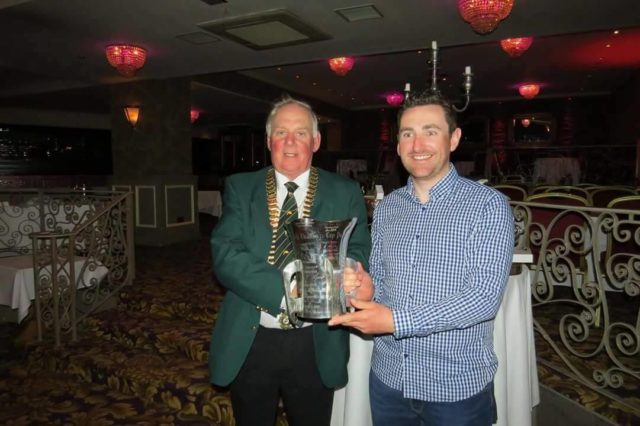
Winner Darren McGuire being presented with the trophy by Albert Berry
Denis Goulding reports that the 84th I.T.F.F.A. National Angling Championship was fished on Lough Owel Mullingar on Saturday 27th of May 2017…
The competition was fished from 10am until 6pm. The forecast proved right for once, with moderate winds and light but incessant rain for the duration of the competition. The lake had fished well over the previous weeks but a change in weather does not help the fishing. 125 anglers took part in the competition and 63 boatmen.
It wasnt a day to stuck in the middle of the boat, but only for the boatmen we could not of held the competition The lake fished well for some, but it was struggle for most of the anglers, it was hard to hold onto fish once connected to them. Rumours on the lake shore at the end of the competition told of a catch of 5 fish, which was an excellent return on the day. Sure enough the rumours were true and Darren Maguire from the Garrison Club took top honours. Well done to Darren Maguire on winning the National Competition at his first attempt.
Winner Darren McGuire being presented with the trophy by Albert Berry
Also a big well done to the 12 Anglers that qualified to fish for Ireland next year and to all the anglers, boattmen and officials that took part in the competition. A big word of thanks must go to the Lough Owel Trout Preservation Association and Chairman Ciaran Kenny for allowing the organisation to fish the competition on Lough Owel, The Leinster Committee and The ITFFA executive committee for helping to organise the event with the Lough Owel Club. A special word of thanks Brendan Murray who organised boatmen and stewards for the competition ,A huge task for anyone, but true to form everzthing went smoothly.
The Qualifiers
1. Darren Maguire 5 fish weighing 6lbs 11. 8 oz
2. Denis Goulding 3 fish weighing 5lbs 5 oz
3. Paddy Ward 3 fish weighing 5lbs 2 oz
4. John Mulvanney 2 fish weighing 5lbs 1 oz
5. Eddie Harte 3 fish weighing 4lbs 15. 6 oz
6. Seamus Kelly 3 fish weighing 4lbs 12. 6 oz
7. Stephen Browne 3 fish weighing 4lbs 10. 8 oz
8. Mike Keady 3 fish weighing 4lbs 9 oz
9. Terry Walsh 3 fish weighing 4lbs 9 oz
10.Dan Murphy 2 fish weighing 4lbs 6. 8 oz
11.John O’Connell 2 fish weighing 4lbs 5. 6 oz
12.Sean Crean fish weighing 4lbs 4. oz
Heaviest fish Michael Callaghan
Michael Callaghan won the Deacy Cup for the heaviest fish with a trout weighing 3lbs 2.4oz
Winner Darren McGuire being presented with the trophy by Albert Berry
Orla Walsh won the McBride Cup as top lady angler with a catch of two trout weighing 3lbs 12.4 oz.
Subs. 1 Frank Kelly, 2 Luke O’Connell, 3 Keith Fleming, 4 Dudley Murphy, 5 Dave Egan, 6 Ciaran Reilly
The 5th edition of this five-day coarse angling festival showcasing the fishing available on the Shannon Erne Waterway in County Leitrim took place from the 22nd to 26th of May. The event saw County Monaghan based feeder angler Shamie Winters fish a close match to win.
Shamie fished a great festival with some good weights against tough competition which saw him take the lead on the final day with a 12kg catch at Connolly’s Shore finishing with just under 50kg in total. Enniskillen Angler Tony Green’s 7.250kg from Lough Scur wasn’t enough to keep the top position he held all week and he finished second with 45.830kg. Runcorn angler Dave Stewart finished in third place with 49.470kg. In 4th was Wayne Fuller and 5th Mark Harris.
Shamie Winters Co. Monaghan
The visiting angler from England represented just under half of the total 40 anglers in attendance who drew their pegs daily Ballinamore’s Tourism Office. Run by Lakelands Angling the club is working closely with the Ballinamore Tourism & Angling Group to highlight the good fishing in the region. The group who have realised the economic potential of angling tourism first attracted the World Pairs Angling Championships to the region in 2012 have now secured funding from Leitrim Council and Inland Fisheries Ireland for venue improvements.
Katrina McGirr from sponsors Waterways Ireland presented the trophy and cash prize of €1000 to Shamie at the presentation evening at Terry Shorts Heritage Bar. The top five all received cash prizes along with numerous section winners.
Ballinamore Tourism & Angling Group would like to thank all those who took part and stayed in the Ballinamore area this week. Thank you to members of Lakelands Angling Ballinamore, local landowners in particular Padraig Mulligan who provided transport at Connolly’s funded by Inland Fisheries Ireland and Irish Bait and Tackle Limited for providing fresh bait.
The Festival next year will take place from Monday 28th May to Friday 1st June 2018.
Report courtesy of National Coarse fishing Federation of Ireland www.ncffi.ie.





 Grey Duster Guiding