



In this edition… As it’s the off season on the river we are going to go back to the beginning – before we ever owned a fishing rod. We will start by talking about the best rod for a beginner and where to start looking for one. Selecting flies can at times be a tricky business, let’s discuss making a plan. We speak to Darius Simkus and ask a few questions about his preferred method. Kevin O’Neill talks us through a nice simple pattern that works well for him. Coarse fishing is also well under way and something I enjoy over the winter with Anthony. We will be looking at different species in each edition and we’ll give some beginner tips.
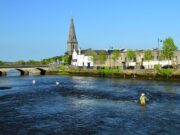
Our first fly rod, how do we choose? First of all, what type of fishing would we like to try. Let’s take a look at my home river first which is the River Nore. My main choice of rod for a day’s guiding / fishing would be a 9ft 5wt rod – so nine feet long and suited to a five-weight fly line.

Why? The 9ft 5wt is what some call the “vanilla” of fly rods. This will cover most applications that you will come across when starting out on a river like the Nore. Another reason we may pick this rod weight is that it is versatile, so talking again about applications here, we can decide if we want to fish wet fly, dry fly, dry dropper or fish with light streamers. This opens up a world of options for us. I mostly start people out with wet fly. Others may have different techniques they start people out with, but my chosen discipline for a beginner is wet fly. As you progress on your journey, you can fine tune your rod weight and length to something that is more specialised to your chosen discipline, but for now let’s focus on finding our preferred discipline without having to own 5 or 6 different fly rods.
Is there more to know when choosing a rod and what is fly rod action? Mostly, you will come across medium to fast action rods when choosing your fly rod. Some are fast action and others ultra-fast action – but what does this mean and what should you choose? The actions go from slow through to fast/ultra-fast. Slow action fly rods are the most flexible and they will bend from the tip all the way to the handle. They are used mostly for smaller streams, delicate presentations and smaller fish species. Medium action rods bend from the tip to about halfway down the fly rod, these offer a good combination of action and power and can be more forgiving for a casting novice than a fast action rod. Fast action rods flex a lot less and bend closer to the tip, which generates high line speeds; this in turn decreases the time it can take for a loop to form on the casting stroke. A lot of rods today are fast action and we have even moved on to ultra-fast action. There are also a few in between styles that combine actions – like medium-fast or slow-medium. This column is for someone who is starting out in fly fishing, as you advance on your journey you can learn more about the actions, but for now, after considering the above, we are looking for a 9ft 5wt medium or medium-fast fly rod.
Where do we go to find such a rod? There are many tackle shops and some angling fairs around the country and most of the fair exhibitors and some shop owners will let you try before you buy. I myself work with Cadence fly fishing and spend my time at the fairs showing people the range of rods and talking to them about what might suit their application best. Go to these fairs or look up some brand ambassadors who will happily help you out and talk you through some options. In the next edition, we will speak about fly lines and how to choose what we need, until then look at some articles on fly rod actions and learn a little more about them.
Flies we will need, let’s keep it simple…
Ok, so we are starting out with an empty fly box, what now?
Let’s take a look at where we are going to fish. Again, I am going to head to my local river here, the River Nore. I have yet to discover a river that a Pheasant Tail nymph does not work in. It’s a very simple pattern but so effective. The Hare’s Ear is also a superb pattern. These two nymphs, with perhaps some hot spots added (i.e. a single spot of bright colour on a drab fly or nymph), work quite well on the river. Now, if we decide to wet fly fish let’s take a quick look at what hatches on our chosen river. I use a Greenwell’s Glory which replicates olives mostly and I find it great early in the season. There are of course more patterns that work well, and some variations, but let’s keep it simple – for we are only beginning we don’t need to fill our fly box. Keep it to perhaps 15 or 20 flies for now.

Don’t forget hatches will vary over the course of the season so you may find that one day the Greenwell’s pattern won’t work as well. So, pay attention to what’s hatching. Take a picture of the flies you’re seeing and take them to a fly tier or ask a friend. Also, keep a little diary of what flies work and when they were effective and then next season you will be a step ahead and may even find yourself writing a blog or helping others along the river bank. This is how you will build your collection and also your knowledge.

I will speak more in depth on each discipline and get a basic pattern for each for all those who are giving tying your own flies a go this winter. Keep an eye out in the next edition where we will go through the tying of some patterns that we speak about.
Tip: Check cobwebs around the riverbank or on bridges, they may hold the secret to what the fish may be taking.
Wading Aids
Ok, so some people reading this may have been there, I am writing it and have been there several times. We are wading on the river and stumble or catch the toe of our boot on a rock and bang, we are in. We must not forget the river can be strong and powerful, it’s very well to sit at home over a cup of tea and think about what you would do if the worst happened and you did fall in, let’s look at how we can minimise the chances of this happening. I use carbide tip studs in the bottom of my boots. My boots are felt sole also and this gives me better grip on slippery surfaces as the studs bite into slimy slippery rocks – although felt soles can transport organisms between waterways and should be dried or disinfected if moving from one river to another. The next thing is a wading staff, no need to spend huge money here, they are a support for you to feel around and to offer some support when moving and of course balance. The most important of all is a life vest/jacket, the one I use has a small canister in it and I pull a drawstring if I fall into the water and, as it inflates instantly, I will have the help I need. Be steady and be safe on the water, it’s much more enjoyable and of course safer.
Ask the Expert
This week’s expert is Darius Simkus. Darius has represented Ireland several times and also captained the Irish team. I asked Darius some questions about nymphing that a beginner may have. Let’s see what Darius had to say.

Can you tell us a bit about nymphing? – Nymphing, often known as fly fishing, is unquestionably one of the most popular types of fly fishing out there. Nymphing is the method of fishing using artificial flies that resemble young aquatic insects, larvae, or other sub-aquatic life forms such as worms and crustaceans that trout find attractive.
Speak to us about bead size and colour, what’s the most important thing to factor with nymph choice when we get to a river? – For me, most important is nymph size and then bead color. I like silver, gold, copper and metallic pink best for my nymphs. Most popular is size 16 and size 18 with 3.5mm and 3mm tungsten bead.
What do you look for when choosing a spot to nymph on the river? – I always start at the end of the pool and work my way upstream, closely looking at the seams of the river and for boulders or something that deflects the current.
How do we set up our rod when beginning to nymph, what size tippet should we begin with and length leader? – These days you have a lot different nymphing styles (Czech nymphing, polish nymphing, Spanish nymphing) all of them you can call euro nymphing. If you’re a competition angler, you have to follow a few rules for nymphing setups and leader lengths, but if you’re a pleasure angler, you can make nymphing leader: 0.20mm or 0.22mm mono line around 5m, then attach same size indicator material (blood knot) about 30 or 40 cm and make small perfection loop at the end. Add your tippet material and your nymphing leader is ready. Tippet size is from 8x to 4x and depends on what average size fish you planning to catch.
Rod and reel for a nymphing beginner, most people speak about a 2wt or 3wt – what would be better for a beginner and what is the main difference? – We can talk about rods all day long and this is a hard question to answer. Every angler is different and each likes a different length, weight and brand of rods. The most popular are 10ft 2# or 3# rods. I like 11ft rods more, but this is my personal opinion.
Beginner tip? – My best tip is to try to spend more time on the water or fish with somebody more experienced than you who can help to guide you on your journey.
Regards Darius aka Mr. Fishy
Beginner Patterns
Kevin O’Neill always has some interesting patterns, let’s see one of his favourites and how he ties it.
“As with all my nymphs I tend to use a dry fly hook as the slimmer wire tends to hook more fish in my experience. For the Pheasant Tail nymph, I like to use a hook with a slightly longer shaft. I typically use a size 16 or 18.
I begin by putting a gold-coloured tungsten bead between 2 and 3 mm on the hook. I tie in a couple of millimetres behind the bead and then dress the hook all the way back to where the barb would typically be. I pull approximately half a dozen fibres off the pheasant tail stem. The tail should be slightly shorter than the body of the fly. I tie these in with a couple of loose wraps and adjust the length and positioning if required.
Once happy, I lift the fibres and with tight wraps, I advance the thread back up towards the bead. I take the wire and tie it in all the way back to the tail. Sometimes I build up a taper with the thread, but this is very much optional. You could apply a very thin layer of superglue along the length of the thread body for extra durability, but this is something I rarely do. I then wrap the fibres away from me advancing up the hook shank. Try to keep the 6 or so fibres together as you do this. Slowly wiggling the bunch as you wrap forward tends to give you a more even distribution.
Also, having a rotary vice will make this stage much easier. Advance the wraps to all the way behind the bead and tie them off. As this version does not have a wing-case you can cut the remainder off. Counter wrap the wire, secure and helicopter it off. I tend to aim for around 4 or 5 wraps. At this point take three peacock herls and tie them in at by their butts beginning approximately 3 or 4 millimetres back from the bead. Wrap all the way forward. For extra durability I take my thread back through the herl and then then forward again before doing a whip finish and cutting away the remainder. I finish the fly by applying a drop of head cement. One little trick is to place it on the top of the bead and let the liquid slide down the back and into the thread wraps.
This fly is a staple in my box, and I fish it throughout the season. I have it in sizes 14 to 18 and vary the diameter and material (tungsten or brass) of the bead. I rarely tie it with a hotspot but if I do this will be achieved by applying a small drop of red or orange Wulff fluorescent UV resin to the top of the bead.
As I’m a big fan of the dry-dropper technique this is how I normally fish it, but I have also caught many a fish whilst dead-drifting or swinging it downstream as the point fly in a team of three wet flies.”

Beginning Coarse Fishing
This week we will be speaking about the mighty red eye and what we need to catch this beautiful fish. The humble roach inhabits quite a few of our waterways. My chosen river is the River Barrow. I grew up about 10 minutes from the river Barrow in Borris, Co. Carlow. I have fished most of the main river and canals along that stretch between Goresbridge and Borris. I took young Anthony back there and introduced him to coarse fishing, but today it’s all about the roach. So, what do we need to start off. I use a 12ft match rod made by Cadence.
What is a match rod? A match rod is used for float fishing, it has many line guides and is flexible or springy, this helps to protect lighter lines and also offers the best sport when we are targeting smaller fish like the roach. When choosing a reel then there is also a match reel, get one that balances the rod you choose. Reels come in different sizes to from 1000 to 12000 or even beyond. We will be looking at a 2000 or 3000-sized reel. There are half sizes to like 2500, for now let’s keep it simple and look for a 12ft match rod with a 3000 sized reel. When loading the reel with line I use Edge Tackle’s float mono in 3-pound breaking strain. Don’t forget we are using a flexible forgiving rod that will protect our 3-pound line.

What does it mean that the rod protects the line? If I tie some 3-pound line to a door handle and yank it suddenly it will snap as the line took all the power I put into the yank. However, if this line was coming out of the rod tip and I yanked it then the rod would bend, so the rod tip absorbed me yanking on the line, thus not breaking the line or snapping it. So, when your fish is fighting or lunging away from you, the rod tip absorbs these movements protecting your line.
How do I set up a float on my line? There are some different floats and float types but let’s hone in on one – the waggler. A straight waggler float is the shape of a pencil, at one end it is a hi-vis color and the other end has a small hole for your line to feed through, when we have fed our line through we hold the float in place or depth by using line stops which are small pieces of rubber than slide onto your line, we need one above and one below your float. We can now slide our float up and down the line, let’s slide it up a bit and tie a hook on. Barbless hooks are best and safest for our friends in the river and of course ourselves.
How do we weight our float? We use things called split-shot or lead shots which are tiny leads that we squeeze on our line under the float to weight it properly so that the float sits vertically and the tip of the float is just above the water surface so we can see bites clearly. We now have a float, lead shots spaced out nicely and our barbless hook. Don’t squeeze the lead shots on too tight as you will pinch the line and it will weaken it and risk it snapping.
What depth do I fish? If we slide our float up the line, it allows the bait to be lower in the water and when we slide the float nearer to the hook, we lift the bait up higher in the water. I always start out on the bottom, so I ‘plumb the depth’ to find out how deep my fishing location, or ‘swim’, is.
What does plumb the depth mean? When we have chosen our swim, we want to start fishing on the bottom, we do this by attaching a lead that our float cannot support meaning it’s too heavy and will pull our float under the water. So, we slide our float up to what we think the depth is and then cast the float in with the heavier weight attached, if the float sinks we will reel in and slide the float further up the line to make it deeper, if the float sits high in the water or on its side when we cast in then we will reel in and move the float down the line closer to the hook as we were over depth.
How close should my lead shot be to the hook? This can vary, if we want the bait to fall naturally to spooky fish, we can keep the lead shot further away from the hook say 20cm for example, if we want to get past smaller fish that sit higher up in the water, we would set our lead shot closer to the hook to get the bait down to the bottom quick where we expect the bigger fish to be.
So, the above is for the beginner and we will look in more detail in the next edition.
Roach “The Mighty Red Eye”
As a child I would sit under the oak tree at the end of the canal at Clashganny. I would look into the water and every now and again 3 or 4 fish would move past almost military like, patrolling their canal in search of intruders (or white maggots in this case). My young mind would imagine the maggots to be intruders dive bombing into the water as I threw them in, trying to get to the bottom before being spotted by the patrolling soldiers – or in this case the roach.
The power of a child’s imagination! I remember my childhood fishing memories as if they were yesterday. However, I am here to help people start out roach fishing not speak of my crazy childhood imagination!!
The humble roach, what a pretty and delicate fish. Roach are shoal fish and can be found in most canals. I float fish for roach on the River Barrow, I mostly use maggots for them but catch some good fish also on breadflake, worms and hemp seed, but I find that stewed wheat can also be used and is very effective. Let’s take a look at the above baits, let’s mix some up and add perhaps 500grams of groundbait.

To get the roach feeding, I find that small amounts of ground bait work well, with some freebies thrown in also at a steady rate. I also find that using stewed wheat and hemp in my mixes tends to produce the larger roach. Of course, roach will take a worm as well, so I sometimes use a single worm on a size 14 Kamasan barbless hook and it is very effective. The mix I use mostly when targeting roach is the following, you can increase the mix by doubling the measurements below,
- 1kg brown crumb
- 2 cups breadcrumb
- Some chopped worms
- Half a cup of crumbly soil
- Add water carefully and slowly to dampen the mix then roll into balls and introduce it to your fishing spot (ensuring it is damp throughout as if it’s not pieces will float sub surface and may even make the fish feed higher in the water).
You can make your own mix also and experiment with things and note your results. Roach tend to hang out in winter time at canal mouths or quite close to the bank. They don’t like to fight hard currents, instead in the winter months prefer to hold up in deeper slow-moving water. Fishing can be very exciting and fun once you get the shoal feeding and start to get through to the larger fish. The activity of the roach of course doesn’t go unnoticed by predators and usually it isn’t long before the pike or big perch come in and pay you a visit. This will spook the roach for a short while, but they should come back in to feed once the predator has their fill.
The Irish Fly Fair
The Irish Fly Fair looks to be even better than last year’s event. There is a great line up of fly casters and fly tyers, as well as lots of trade stands. I will be there with the Association of Professional Game Angling Instructors (APGAI) and Cadence.

On the day there are many exhibitors, but there will also be one on one casting tuition available and provided by APGAI and the Game Angling Instructors Association (GAIA), both in double and single-handed casting. There is also a kiddie’s casting area which was very well run by Ray McKeeman and his team last year. Hints, tips and fishing knowledge will be in abundance, make sure and stop by.